Share it with your network.


Key Takeaways
- AI checks a shelf photo against the plan: right display, right products, right placement.
- SKU recognition is what lets the system tell one product apart from another in that photo.
- The output is a compliance score plus a specific list of what's wrong, not a plain pass/fail.
- It replaces the manual legwork of finding problems, not the manager's judgment in fixing them.
Every merchandising manager runs the same mental checklist on a store visit, whether they'd describe it that way or not. Is the display actually set up the way the guide says it should be? Are the right products on the shelf, in the right quantities? And does what's in front of them match what head office agreed with the retailer? For most of retail's history, answering those three questions meant a person walking the aisle with a clipboard, a planogram printout, and a fair amount of judgment calls.
Image recognition now runs that same checklist from a photograph. It compares a shelf against the guide, flags what's missing or misplaced, and scores how closely the display matches what was planned, at a scale no field team could cover store by store. This is not a new category of retail technology bolted onto merchandising. It is the same manager's eye, automated, and made consistent across a network of thousands of stores instead of the handful a rep can physically visit in a week.
This piece looks at how visual merchandising AI actually performs that check: what it's evaluating when it scores a shelf, and the SKU-level recognition underneath that makes the scoring possible in the first place. If you're looking for the broader case on why AI is reshaping store audits generally, that's covered in our piece on AI in store merchandising audits; this one stays specifically on the compliance-and-recognition mechanics.
1. What a Merchandising Manager Actually Checks on a Store Visit
Before getting into how AI performs this check, it's worth being precise about what the check itself actually involves, because "visual merchandising compliance" gets used loosely. In practice, a manager or field rep evaluating a shelf is really answering three separate questions, in order.
Is the display set up the way it's supposed to be? This is the physical execution of the plan: whether a secondary display or endcap has actually been built, whether shelf strips and header cards are in place, whether the fixture itself matches what the brand and retailer agreed to. A perfectly stocked shelf on the wrong fixture, or in the wrong aisle, still fails this check.
Are the right products present, in the right quantities? This is where availability and assortment meet. A display can be built correctly and still be missing half its SKUs, showing three facings of one variant where the plan called for six, or carrying a product that was supposed to have been swapped out for a newer launch weeks ago.
Does the shelf match the planogram? This is the compliance question that ties the first two together: not just whether products are present, but whether they're in the specific positions, adjacencies, and shelf levels the plan specifies. Eye-level placement for a hero SKU is only a win if it's actually eye-level, not two shelves down where it was supposed to be a competitor's product.
A manual audit answers these three questions by eye, store by store, which is precisely why compliance data has historically arrived late and inconsistently: a rep's read on "close enough" varies, and coverage is limited to however many stores a field team can physically visit in a cycle. Visual merchandising AI is built to answer the same three questions from a photograph, consistently, at every store in the network. The rest of this piece looks at how it does that, starting with what the compliance check actually looks like in practice.
2. How Visual Merchandising Compliance AI Reads a Shelf
Visual merchandising compliance AI works from a single input: a photograph of the shelf, aisle, or display, usually captured on a field rep's phone during a routine visit, or by a fixed camera mounted at the shelf. Everything downstream, from the compliance score to the corrective task a rep receives, starts from that image.
From Shelf Photo to Structured Data
The first job of the system is to turn an unstructured photo into structured data: every product visible on the shelf, identified individually, along with its position, facing count, and shelf level. This step is what separates visual merchandising AI from a general-purpose image classifier. A model that can tell "shampoo" from "toothpaste" is not useful for compliance; the system needs to know that the third bottle from the left, second shelf, is a specific 200ml SKU of a specific brand, not just a bottle.
Comparing the Shelf Against the Plan
Once the shelf has been converted into a structured list of products and positions, the system compares that list against the planogram, the brand's Perfect Store standard, or whatever reference the compliance check is being run against. This comparison surfaces the same gaps a manager would look for: a missing SKU that represents an on-shelf availability failure, a facing count below plan, a product placed on the wrong shelf, or a competitor's product occupying space that should count toward the brand's share of shelf.
The Compliance Score
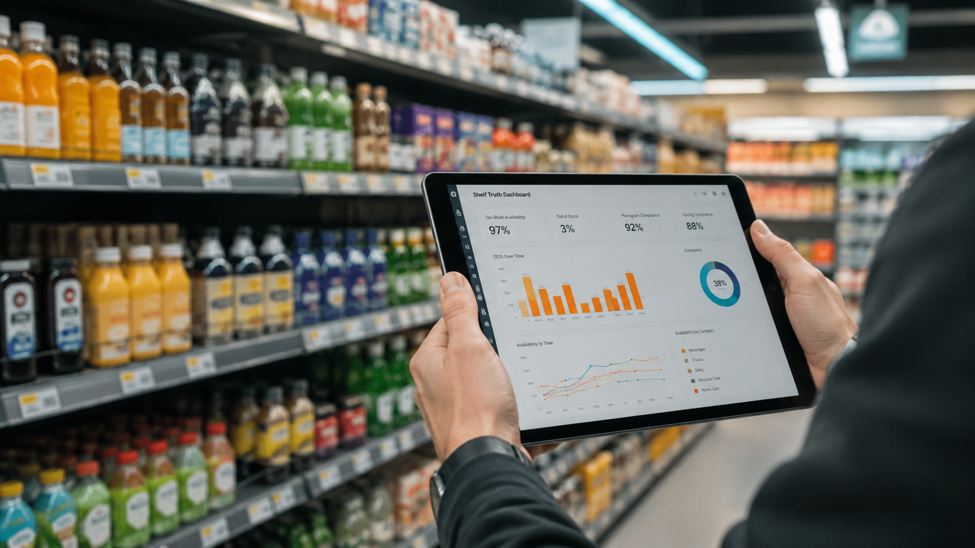
The output of that comparison is a compliance score, along with the specific list of discrepancies that produced it. A store might come back at 78% planogram compliance, with the shortfall attributed to two missing SKUs and one incorrect shelf position, rather than a vague sense that "the shelf didn't look right." That specificity is what makes the score actionable: a field rep or store associate knows exactly what to fix, without needing to re-inspect the entire shelf from scratch.
This is the layer most people mean when they talk about visual merchandising compliance AI. But the compliance score is only as reliable as the layer underneath it, the part of the system responsible for correctly identifying which product is which in the first place. That is SKU recognition, and it's where the real technical difficulty lives.
3. SKU Recognition: The Technology Behind the Compliance Check
SKU recognition is the specific computer vision task of identifying an individual product, down to variant, flavor, and pack size, from its appearance in a photograph. It is the mechanism that makes everything described in the previous section possible: a compliance score is only accurate if the system correctly identified every product on the shelf to begin with.
Object Detection: Finding Every Product on the Shelf
The first stage is object detection, locating every individual product on the shelf and drawing a boundary around it, regardless of how tightly packed, angled, or partially hidden it is behind another item. A crowded gondola shot can contain over a hundred individual facings, and the detection stage needs to isolate each one before any identification can happen.
Optical Character Recognition: Confirming What Each Product Is
Once a product has been located, the system needs to determine exactly which SKU it is. This is where optical character recognition (OCR) works alongside visual matching: packaging color, shape, and label design narrow down the candidate, and OCR reads the text on the pack, brand name, variant, pack size, to confirm the match. Combining the two is what allows the system to tell apart two SKUs that look nearly identical on the shelf but differ in pack size or flavor variant.
Why Accuracy at the SKU Level Is Hard
Shelf photos are rarely clean. Products get rotated so their label faces sideways, blocked partially by neighboring items, or photographed under uneven store lighting. Each of these conditions makes recognition harder than identifying a product from a clear, front-facing catalog image.
.png)
4. Teaching AI to Recognize a New Product
A shelf recognition system is only useful if it stays current, and CPG portfolios don't stay still. New launches, packaging refreshes, and regional pack variants show up constantly, and every one of them is, from the model's perspective, a product it has never seen before.
Historically, adding a new SKU to a recognition system meant collecting a large set of labeled images and retraining the model, a process that could take weeks, long enough that a new product could be in and out of a promotional window before the system caught up to it. ParallelDots built Saarthi specifically to close that gap: it's an AI training platform designed to detect new or previously unrecognized SKUs on the shelf within 48 hours, without requiring a data science team to manually curate a large training set. For a brand running frequent launches or managing regional pack variants across markets, that turnaround is the difference between compliance data that reflects the current portfolio and a system that's perpetually a few weeks behind it.
5. From Detection to Action: What a Compliance Report Looks Like
Put the pieces together and the workflow looks like this in practice. A field rep photographs a shelf during a routine visit. SKU recognition identifies every product in the frame, down to variant and pack size, including any new launches picked up by recent model updates. The system compares that list against the planogram and returns a compliance score, alongside a specific breakdown of what's driving it.
Consider a brand running a seasonal display across 2,000 stores. Instead of waiting for a sample audit to estimate compliance across the chain, the brand can see, store by store, which locations built the display correctly, which are missing specific SKUs, and which have the display up but with the wrong facing counts. A regional pattern, say, one distributor's stores consistently missing the same two SKUs, becomes visible immediately rather than surfacing weeks later in aggregated sales data. That specificity is what turns a compliance score from a reporting metric into something a field team can act on the same day.
See This Running on Your Own Shelves
Every example in this piece is describing a live ShelfWatch workflow, not a concept. Request a demo and see a compliance score built from your own planogram and your own SKUs, not a generic template.
6. Where AI Fits Alongside Merchandising Teams
None of this replaces the merchandising manager's judgment about why a display isn't working, how to negotiate better shelf space, or what a category should look like next quarter. What it replaces is the manual, store-by-store legwork of confirming whether a plan was executed as agreed. That's a meaningful distinction: a manager or field rep spending their time interpreting a clear compliance report and deciding how to fix a problem is a better use of their expertise than spending it walking every aisle to find the problem in the first place.
In practice, this shows up as a division of labor. The AI layer handles detection, consistently, at every store, every visit. The people on the team handle everything that requires context the system doesn't have: relationship management with a retailer, a call on whether a persistent compliance gap is worth escalating, or a judgment about whether a new display concept is actually working with shoppers. Visual merchandising AI, and the store execution AI layer built around it, is most useful exactly where that split is respected.
How ShelfWatch Puts Visual Merchandising AI to Work at Scale
Everything described above, the three-question compliance check, the shelf-to-score pipeline, the SKU recognition underneath it, is what ParallelDots' ShelfWatch runs on. It's deployed across 50+ countries and processes millions of shelf images every month for CPG brands in personal care, packaged food, dairy, OTC pharma, and beverages, which means the recognition challenges described in this piece, rotated packaging, partial visibility, uneven store lighting, aren't edge cases for ShelfWatch; they're the everyday input.
The practical effect for a brand is that the three questions a merchandising manager asks on a store visit get answered at every store in the network, not just the ones a field team can reach in a given cycle. And when a new product launches or a pack redesign ships, Saarthi keeps the recognition model current within 48 hours, so compliance data doesn't lag behind the portfolio it's meant to be measuring.
Further Reading
- How AI Image Recognition Is Transforming Store Merchandising Audits
- Winning Visual Merchandising Principles for CPG Retail Success
- Planogram Compliance in Retail
- Share of Shelf: Why It Matters and How to Measure It
- On-Shelf Availability and Its Business Impact
Ready to See Visual Merchandising AI on Your Own Shelves?
Get a live compliance score built from your own planogram and SKU catalog, not a demo dataset.
.png)
.png)