Share it with your network.


CPG Supply Chain Challenges & Solutions
Key Takeaways
- CPG supply chains are fully instrumented up to the store and largely blind from the back room to the shelf.
- "In stock" and "on the shelf" are different claims – conflating them is what makes out-of-shelf losses invisible.
- The loss is small per store and large in aggregate, which is exactly why no exception report catches it.
- Closing the gap means observing the shelf directly; no amount of upstream data solves it.
A CPG supply chain can be accurate to the distribution centre. Accurate to the back room. Every case scanned in, every pallet reconciled, every system reporting exactly what it should. And it can still fail – reliably, expensively – at the one point that actually decides whether a sale happens: the shelf.
This is the blind spot most conversations about cpg supply chain challenges skip. Inventory accuracy, demand forecasting, and network optimisation all assume that what the system says is on the shelf is what's actually on the shelf. That assumption holds right up until the last scan – the moment a case is received or a store associate checks it into the system. After that, nothing upstream is watching. The product could be facing the wrong way, buried behind another SKU, or simply gone, and every dashboard a brand relies on would still say "in stock."
This blog covers where CPG supply chains typically break, why the hardest failure to fix is the one that happens after visibility ends, and what closing that gap actually requires.
What CPG Supply Chain Management Actually Spans
CPG supply chain management is the end-to-end coordination of sourcing, manufacturing, warehousing, distribution, and retail fulfillment for consumer packaged goods. Most cpg supply chain management solution categories – ERP, WMS, TMS, control towers – are built to instrument that path, and for the segments they cover, they do it well. A brand can usually say, with reasonable confidence, where a pallet is between the plant and the retailer's distribution center.
Where that confidence runs out is the segment after the retailer takes possession. Distribution gets measured. Fulfilment gets measured. What happens between the back room and the shelf – the segment where the product actually becomes a sale – typically isn't measured by any of these systems. It isn't that the data is wrong. It's that no data exists.
The CPG Supply Chain Challenges Most Brands Already Manage
Most CPG supply management functions have built real muscle around the upstream challenges. They're worth naming briefly, because they set up why the retail-facing ones are so easy to miss:
- Demand volatility and forecast error. A promotion that doubles expected velocity for two weeks, seasonal swings, and shifting consumer preferences all move demand faster than standard planning cycles react. SKU proliferation compounds it – every new variant and pack size is another individual forecast that can go wrong.
- Supplier and input cost pressure. Longer or less predictable lead times, rising input costs, and single-source dependencies add risk to plans built on steadier assumptions. Dual sourcing, safety stock modeling, and scenario planning have all matured, but this stays an active discipline rather than a solved problem.
- Fragmented systems and data silos. ERP, WMS, TMS, and retailer-specific portals rarely share a common data model, which means supply chain, sales, and marketing teams often work from different versions of what's happening. Closing this is usually a multi-year integration effort, not a single purchase.
- Retailer compliance and deductions. Chargebacks tied to OTIF misses, labeling errors, and documentation gaps create a steady administrative drag that most brands manage through dedicated deduction workflows.
Solve all four well and a brand still hasn't solved the one that decides whether a specific product sells in a specific store on a specific day – because none of them extend past the store's receiving dock.
Where CPG Retail Supply Chain Management Gets Harder
The challenges in CPG retail supply chain management are a different category, because they involve a system the brand doesn't own: the retailer's own store operations.
Retailer scorecards measure shipping performance, not shelf outcomes. OTIF and fill-rate metrics tell a brand whether it delivered what it promised, when it promised it. They say nothing about what happened to that product afterward. A brand can be a top-tier partner on every metric a retailer tracks and still be losing sales at the shelf, because none of those metrics were designed to look past receiving.
Store-level inventory records drift from physical reality. Miscounts, misplaced cases, and incorrectly processed returns accumulate quietly. Research published by ECR Retail Loss in June 2025 – covering 11 UK grocery stores and more than 24,000 SKUs – found that approximately 65% of SKUs carry some level of inventory record inaccuracy. In the same study, correcting those records through audits was associated with an 11% increase in store-wide sales over the following two months. None of this drift registers as an error anywhere. It just registers as a number that's slightly, then significantly, wrong.
"In stock" and "on the shelf" are not the same claim. This distinction is the one most supply chain reporting can't make:\
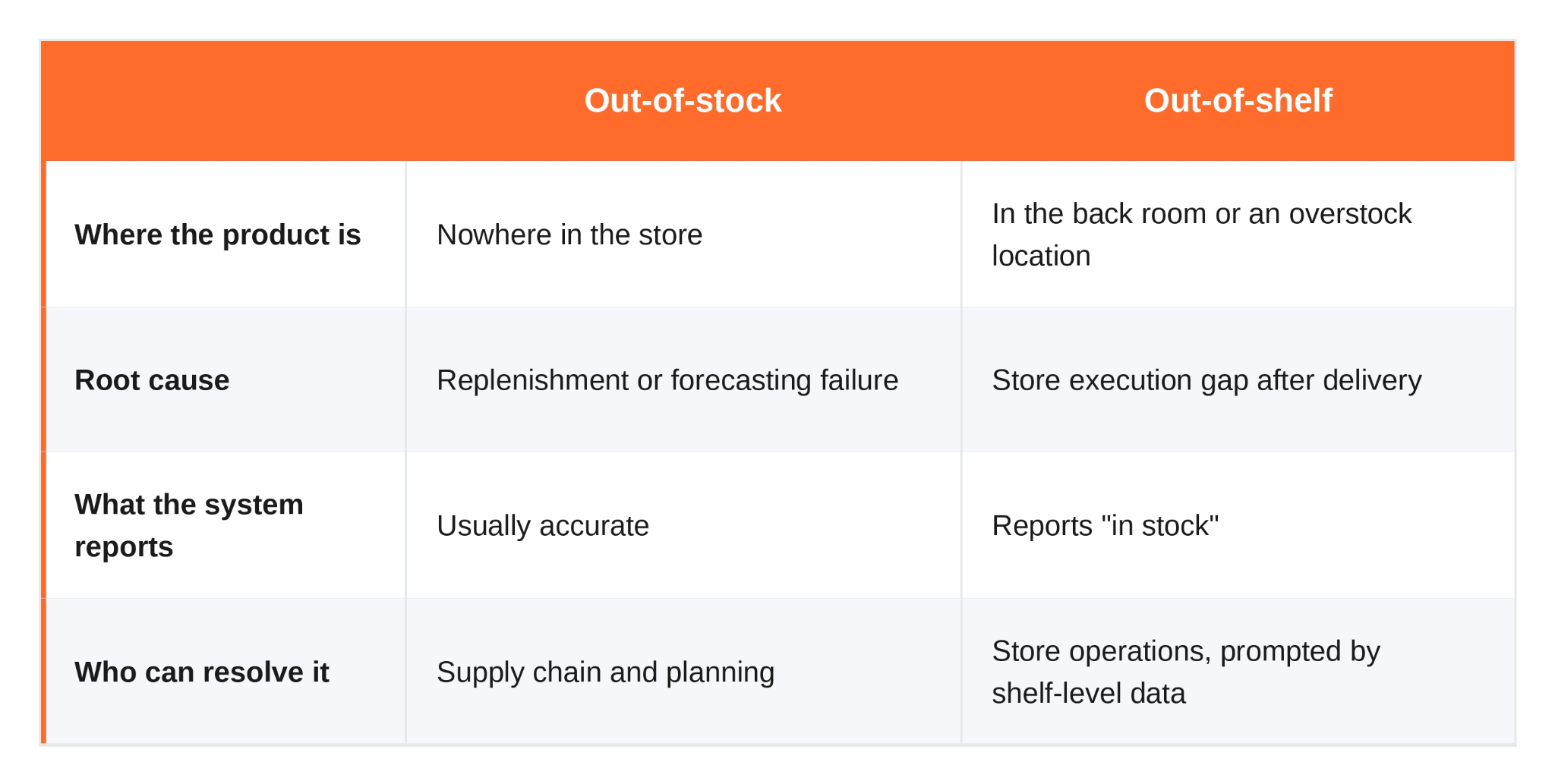
Both look identical to a system that only tracks whether inventory exists somewhere inside the four walls. Only one of them is a supply chain problem in the traditional sense.
The Visibility Cliff: Why the Last Scan Isn't the Last Mile
Every system in a modern CPG supply chain runs on scans and confirmations: the WMS scan when a pallet leaves the DC, the ASN confirmation when a shipment is booked, the receiving scan when a store checks in a delivery. Each is a real, trustworthy data point. Chain them together and a brand gets a genuinely accurate picture – right up to the moment the last one happens.
After the receiving scan, the chain ends. Nothing in a standard CPG supply chain stack observes what happens between a product being checked into a store's system and that same product being scanned at checkout. That segment – often a few dozen feet, and anywhere from hours to weeks in time – is where a product has to physically get onto the shelf, stay stocked, stay faced, and stay findable. It's also where a system can report full confidence and be completely wrong.
What the gap costs: a worked example
Take a single SKU across 400 stores. Assume it sells 40 units per store per week at a $4.50 average retail price – illustrative volumes, but typical shape for a mid-velocity grocery item. At full availability, that's 16,000 units and $72,000 in weekly chain sales.
The IHL Group 2026 Inventory Distortion Study puts global inventory distortion at $1.7 trillion, or 6.2% of retail sales, with out-of-stocks accounting for 65.6% of that total. Empty shelves alone are the single largest cause, at $690.9 billion. Net it out, and roughly 4% of sales disappear because the product isn't available to buy. Apply that to the SKU above, and it's about $2,900 a week, or roughly $152,000 a year – on one SKU.
Here's the part that explains why it goes unnoticed: spread across 400 stores, that's about $7 per store per week. No regional manager escalates $7. No exception report flags it. No scorecard captures it, because every shipment arrived on time and in full. The loss is only visible in aggregate, and the systems that could aggregate it never collected the data in the first place.
This is why phantom inventory is so persistent. It isn't a data-entry error waiting to be corrected – it's the predictable output of a supply chain that was never instrumented past the handoff to store operations.
Who Actually Owns the Shelf Gap
One reason this gap stays open is that it sits between job descriptions. Supply chain teams are measured on service levels and fill rates, and by those measures they're performing. Store operations owns the physical shelf but works across hundreds of brands with limited labor. The team with the clearest commercial stake is usually retail execution – the sales, trade marketing, and field teams accountable for what a shopper actually encounters in the aisle.
That's also the team whose targets depend on it most directly. Perfect store programs, planogram compliance, promotional execution, and share of shelf all assume the product is physically present and correctly placed. When it isn't, the entire execution program is measuring something that didn't happen. Treating the shelf gap as a supply chain problem alone tends to leave it unowned; treating it as a retail execution problem gives it a team with both the mandate and the motivation to close it.
CPG Supply Chain Solutions, In the Right Order
Most cpg supply chain solutions strengthen a specific segment of the chain. They're worth evaluating in the order the chain actually breaks:
- DC-to-store accuracy. WMS accuracy, ASN reliability, receiving discipline. Most mature supply chain functions have already invested here, and errors at this layer propagate downstream, so it's worth confirming as solid.
- Retailer compliance. OTIF and fill-rate performance directly affect retail relationships, and scorecarding, deduction management, and EDI compliance tooling address brands still exposed here.
- Shelf-level visibility. Once product reliably reaches the store, the largest remaining source of unexplained loss is the segment between the back room and the register – the one no traditional supply chain tool was built to observe.
These layers compound rather than compete. Brands with the first two already under control tend to see the fastest return from the third, because shelf data lands on a chain that's reliable upstream. Brands still working through the first two often find that shelf data is what tells them where their upstream problems are actually surfacing – a recurring gap in one chain's stores reads very differently from the same gap scattered at random.
For brands still building distribution fundamentals, our guide to CPG distribution and logistics strategies covers the groundwork in more depth.
Closing the Gap with Shelf-Level Data
This segment has stayed unsolved because closing it requires a different kind of data than the rest of the chain runs on. Every other layer is instrumented through scans and system-of-record updates. The shelf can only be instrumented by observing it directly – traditionally through manual audits, and increasingly through image recognition that captures the same information continuously rather than in periodic snapshots.
That's the gap ParallelDots built ShelfWatch to close. Instead of inferring shelf state from upstream records, it uses image recognition to observe the shelf itself – on-shelf availability, planogram compliance, and share of shelf – and converts that into store-level data teams can act on while the sale is still recoverable. It complements the rest of the supply chain stack by picking up exactly where its visibility runs out. Our breakdown of AI Ops for CPG covers how this works in practice.
FAQs
What is CPG supply chain management?
CPG supply chain management is the end-to-end coordination of sourcing, manufacturing, warehousing, distribution, and retail fulfillment for consumer packaged goods. It's typically measured by how accurately and efficiently product moves from raw material to the point where a retailer takes possession.
What are the biggest CPG supply chain challenges?
The most common are demand volatility and forecast error, supplier and input cost pressure, fragmented systems that prevent a single source of truth, and retailer compliance deductions. At the retail interface, two more emerge: scorecard metrics that don't capture shelf outcomes, and store-level inventory records that drift from physical reality over time.
What is the difference between out-of-stock and out-of-shelf?
Out-of-stock means the store has no units anywhere on the premises. Out-of-shelf means units exist — usually in the back room or overstock — but aren't available for a shopper to find and buy. Standard inventory systems generally can't distinguish the two, which is why out-of-shelf losses persist.
Why does a system show a product as "in stock" when it isn't on the shelf?
Because inventory systems update from scans — at the DC, at shipping, at store receiving — and nothing scans the shelf itself. Once a product is checked into a store's system, there's typically no further data point until it sells, so any gap between the back room and the shelf goes unrecorded.
How do you improve CPG supply chain visibility?
Upstream visibility improves through integration: aligning ERP, WMS, and retailer data on a shared model so teams work from one version of events. Downstream visibility past the receiving dock can't be integrated into existence, because no system generates that data — it requires observing the shelf directly, through audits or automated image recognition.
What are the best CPG supply chain solutions for closing the shelf gap?
It depends where the chain is breaking. DC-to-store accuracy and retailer-compliance tooling address the upstream layers. For brands where those are already strong, shelf-level monitoring — image recognition capturing on-shelf availability, planogram compliance, and share of shelf — is typically the highest-leverage remaining gap.
.png)
.png)