Share it with your network.


TPM vs TPO: What's the Difference, and Which One Do You Actually Need?
The difference between trade promotion management and trade promotion optimisation is one of the most consistently blurred distinctions in CPG commercial strategy – and the confusion is expensive. A brand buys a TPM system expecting it to tell them which promotions are worth running or invests in a TPO expecting it to fix a broken settlement process, and neither delivers, because that was never the job it was built for.
The stakes justify getting it right. In the Promotion Optimisation Institute's 2026 State of the Industry research, nearly 68% of CPG companies reported allocating more than 15% of annual revenue to trade promotions – many between 16% and 23%, with a segment exceeding 27%. Only 14% described themselves as fully satisfied with what that spend returns.
TPM is the system of record: it plans, executes, and settles trade spend. TPO is the analytical layer on top of it: it decides where that spend should go. Knowing the definitions matters less than knowing which problem a brand actually has – and recognising that neither system answers the question of whether the promotion ran correctly on the shelf.
Key Takeaways
- TPM (Trade Promotion Management) handles the process: planning, executing, and settling trade promotions – budgets, deductions, and accruals.
- TPO (Trade Promotion Optimisation) handles the decision: using historical data and modelling to determine which promotions are worth running and at what discount depth.
- They solve different problems. TPM fixes broken processes, and TPO fixes poor spend allocation. Most brands eventually need both.
- Neither TPM nor TPO verifies whether the promotion was executed correctly in-store. That requires a third, parallel layer: store-level execution data.
What Is Trade Promotion Management (TPM)?
Trade promotion management (TPM) is the system that plans, executes, and financially settles trade promotions. It covers the mechanics finance and sales teams handle daily: off-invoice discounts, bill-backs, scan-downs, deduction management, and the accrual accounting that reconciles committed spend against actual claims.
A TPM system answers one question: what did we commit to, and did the numbers match at settlement? It is not built to evaluate whether a promotion was a good idea. It is built to ensure that once the decision is made, the money is tracked, documented, and paid out correctly.
For brands still running trade spend through spreadsheets and email approvals, TPM is usually the first fix. Disputed deductions and untraceable accruals erode margin long before optimisation becomes a relevant question. Our complete guide to trade promotion management covers the trade-spend vehicles and software considerations in more depth.
What Is Trade Promotion Optimisation (TPO)?
Trade promotion optimisation (TPO) is the analytical layer that determines which promotions are worth running before the money is committed. Where TPM tracks what happened, TPO models what should happen.
It uses historical lift data, pricing elasticity, and scenario simulation to answer a different set of questions: which SKUs respond to discount depth versus promotional frequency, what discount level drives genuinely incremental volume rather than pulling forward sales that would have happened anyway, and how promoting one product cannibalises the rest of the category.
TPO sits upstream of execution. It doesn't run the promotion or process the settlement – it informs whether the promotion should exist in its current form at all. Brands typically reach for TPO once the promotional calendar has stopped being a strategic exercise and become a copy of last year's plan, adjusted for budget. Our guide to building a trade promotion optimisation strategy goes deeper on implementation.
TPM vs TPO: The Difference Between Trade Promotion Management and Trade Promotion Optimisation
TPM manages the process of running a promotion. TPO decides whether that promotion should run at all. That single distinction resolves most of the confusion – these systems sit at different points in the same workflow, not in competition with each other.
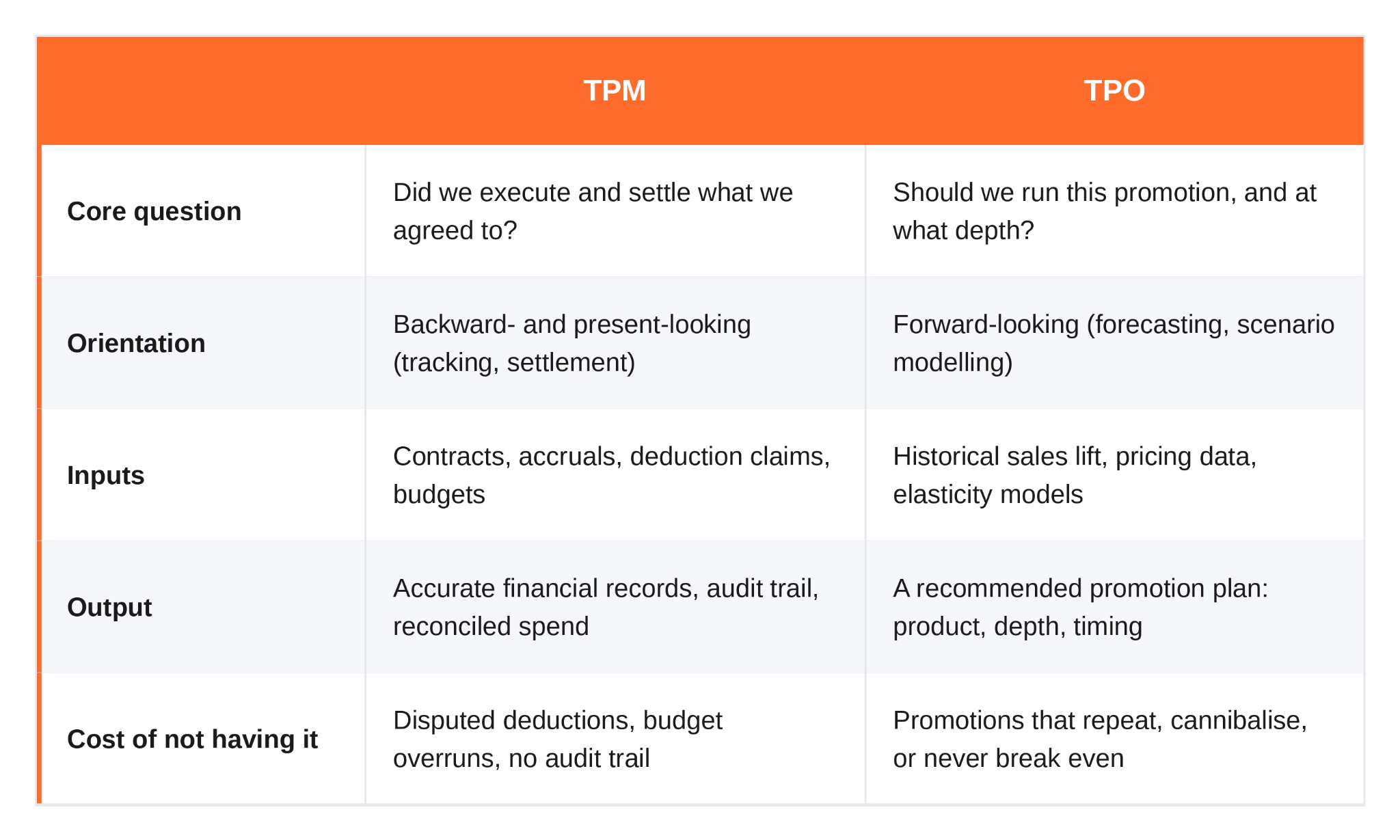
The dependency runs in both directions. A TPM system without TPO produces clean records of promotions that may not have been worth running. A TPO model without reliable TPM data produces confident, well-formatted recommendations built on numbers that were never accurate to begin with.
Which One Does Your Brand Actually Need?
The answer depends on which problem is costing money right now – and in practice, it is almost always one of two.
If the recurring problem is process, the answer is TPM. That looks like deductions that can't be traced to a specific promotion, settlement cycles measured in months, finance and sales working from different numbers for the same campaign, or no clean audit trail when a retailer disputes a claim. These are operational failures. No amount of analytical sophistication resolves them – a system of record has to come first.
If the recurring problem is spend allocation, the answer is TPO. That looks like a promotional calendar copied forward year over year, no reliable way to separate incremental volume from forward-buying, and discount depths set by retailer pressure or convention rather than evidence. These are decision failures, and a better ledger won't fix them.
Most mature trade spend functions eventually run both, and the sequencing matters: TPO models built on unreliable TPM data inherit that unreliability and present it with more confidence. But treating this as a strict two-step queue is where brands get caught out. Execution visibility is not the third step after TPM and TPO are complete – it runs parallel to both, and its absence distorts the data each of them depends on.
The Blind Spot Both TPM and TPO Share
Neither system can confirm whether the promotion ran the way it was planned, in the store, on the day it mattered.
TPM records what was committed and what was settled financially. TPO models what should happen based on historical data. Both operate on planned or reported information. Neither has direct visibility into whether the discounted price reached the shelf tag, whether the promotional display went up on schedule, or whether the SKU was in stock during the promotional window.
This is not a flaw specific to any vendor or platform – it is a structural boundary of what these two software categories are designed to do. A promotion can be planned correctly by TPM standards and modeled well by TPO standards and still underperform because it was never executed as designed at store level.
The consequence compounds. When execution gaps go unmeasured, they get absorbed into the performance data as though they were demand signals. A promotion that underperformed because displays went up late is recorded as a promotion that didn't resonate with shoppers – and the TPO model learns from that mislabelled outcome, carrying the error into the next planning cycle.
A Quick Example: When "Optimised" Doesn't Mean "Executed"
Consider a mid-sized CPG brand using TPO to model a promotion. The analysis recommends a 20% discount on a specific SKU across a retail chain for two weeks, projecting strong incremental lift with limited cannibalisation of the full-price line. The recommendation is sound – the model did its job. TPM then processes the deal: the off-invoice discount is configured, terms are agreed with the retailer, and the accrual is booked.
Two weeks later the results come in soft.
On paper, both systems performed correctly. What neither could see is that the promotional shelf tag went up three days late across a third of the stores, and the secondary display was never built in several locations because of a shelf reset conflict. The spend was optimised. The spend was tracked accurately. The promotion itself was only partially executed – and nothing in either system was built to catch it.
How Brands Close the Execution Gap
Closing this gap requires store-level verification of what actually happened on the shelf, and the method matters as much as the intent.
Self-reported field data is the most common approach and the least reliable, because the team executing the promotion is also the team scoring it. Third-party manual audits improve objectivity but arrive lagged and sample only a fraction of stores – by the time the findings land, the promotional window has usually closed.
Image recognition-based retail execution monitoring is the category built to solve this. A field rep or merchandiser photographs the shelf during a routine store visit, and AI analyses the image to verify planogram compliance, share of shelf, pricing accuracy, and product availability against what was planned. The verification becomes a by-product of a visit that was already happening, which is what makes store-level coverage economically viable rather than a sampling exercise.
The operational difference is measurable. ShelfWatch delivers 84% accuracy compared with manual retail audits while cutting per-store audit time by 60%. The compliance gains follow from the visibility: a food products company running general trade across 10,000+ outlets recorded a 30% improvement in planogram compliance within the first two months, and a global cleaning products brand operating 100+ SKUs across 5,000+ modern trade outlets saw a 25% improvement in on-shelf availability within three months.
Those figures matter to trade promotion specifically because display compliance and on-shelf availability are the two execution variables that most often separate a promotion's modeled performance from its actual result. Feeding verified execution data back into the trade promotion cycle doesn't replace TPM or TPO – it tells both systems whether the thing they planned and paid for actually happened.
Frequently Asked Questions
What is the difference between trade promotion management and trade promotion optimization?
Trade promotion management (TPM) handles the planning, execution, and financial settlement of trade promotions. Trade promotion optimization (TPO) uses analytics and historical data to decide which promotions are worth running and at what discount depth. TPM manages the process; TPO informs the decision.
Is TPO a replacement for TPM?
No. TPO is an analytical layer that typically sits on top of TPM data rather than replacing it. A brand still needs a reliable system to plan, execute, and settle promotions after TPO has determined which promotions to run.
What comes first, TPM or TPO?
TPM generally comes first, since TPO models depend on accurate promotional and financial data to produce reliable recommendations. Execution visibility, however, is not a third step – it runs alongside both, because it determines whether the data feeding either system reflects what actually happened in-store.
Do smaller CPG brands need TPO, or is TPM enough?
It depends on promotional complexity rather than company size. A brand running few promotions with straightforward terms may not need TPO's modeling capability yet, though execution verification still applies – a small brand's promotional budget is proportionally just as exposed to compliance failures as a large one's.
Why would a promotion underperform even when TPM and TPO are working correctly?
Because neither system verifies store-level execution. A promotion can be planned accurately and modeled well and still underperform if the shelf tag went up late, the display was never built, or the SKU was out of stock during the promotional window.
.png)
.png)