Share it with your network.


Table of Contents
- What Is Retail Intelligence Software? (A Working Definition)
- Key Takeaways
- The Two Flavors of Retail Intelligence Software Buyers Actually Find
- The Missing Layer: Where Shelf-Level Data Actually Comes From
- Retail Intelligence Software vs. Shelf Analytics: What's the Difference?
- Where ShelfWatch Fits
Retail intelligence software has become a catch-all term. Depending on which vendor is using it, it can mean shopper data unification and personalised marketing, or assortment and pricing recommendations built on aggregated sales data, or something else entirely. For a buyer trying to fix a specific problem, usually something happening in physical stores, the label rarely maps cleanly onto what they actually need.
The confusion has a simple cause: 'retail intelligence software' is a genuinely broad category, but most content written about it defines the term from one side of the business, typically e-commerce and marketing, without acknowledging that physical retail decisioning runs on a different set of inputs entirely.
This piece defines what retail intelligence software actually does, breaks down why the category splits into distinct types depending on which business function it serves, and explains where image-recognition-based store execution fits into a decision stack that most retail intelligence platforms simply assume already has accurate data to work with. For anyone comparing vendors or trying to get the vocabulary straight before a budget conversation, this is the layer that usually gets skipped.
What Is Retail Intelligence Software?
At its core, retail intelligence software is any platform that pulls together data from multiple parts of a retail business, shopper behaviour, product performance, pricing, inventory, or in-store execution, and turns it into decisions rather than just reports. That distinction matters more than it sounds. A dashboard showing last week's sales by SKU is retail analytics. A system that uses that same data to flag a demand shift, recommend a price change, or trigger a replenishment alert before the problem compounds is retail intelligence.
Retail analytics answers "What happened?" Retail intelligence software is built to answer "What should happen next?" and increasingly, to act on that answer without waiting for someone to read a report. That decision layer is what separates the category from standard business intelligence tooling repackaged for retail.
In practice, a retail intelligence platform is built around three functions:
- Data unification: connecting sources that normally sit in separate systems, POS, ERP, CRM, loyalty, in-store execution, so a single decision can account for signals that used to live in different silos.
- Prediction: applying models to that unified data to forecast demand, flag anomalies, or estimate the outcome of a pricing or merchandising change before it is made.
- Action: pushing the output somewhere it changes behaviour, a triggered campaign, a markdown recommendation, a replenishment alert, an escalation to a field rep, rather than leaving it in a dashboard for someone to notice.
Where retail intelligence software differs sharply from vendor to vendor is which part of the business those three functions are built around. That split is worth understanding before evaluating any specific platform.
Key Takeaways
- Retail intelligence software turns unified retail data into predictions and actions, not just reports.
- The category splits into shopper-side platforms (personalisation, marketing) and store-side platforms (assortment, pricing, promotion) – most vendors serve one, not both.
- Retail intelligence is the decision layer; shelf analytics is the execution layer. The two are complementary, not competing.
- For physical retail, image-recognition-based store audits typically supply the data that retail intelligence decisions depend on.
The Two Flavors of Retail Intelligence Software Buyers Actually Find
Most platforms marketed as retail intelligence software fall into one of two groups, and the difference comes down to which side of the revenue equation they were built to serve. The category is growing quickly either way: retail intelligence software is projected to grow from $11.44 billion in 2026 to $18.43 billion by 2029, according to Research and Markets.
The first group is built around the shopper. These platforms unify identity, browsing behaviour, purchase history, and campaign response into a single customer view, then use that view to personalise offers, sequence lifecycle campaigns, and predict churn or lifetime value. The data sources are digital by nature: ecommerce events, email and SMS engagement, loyalty transactions, and paid media. For a brand whose growth problem is conversion, retention, or campaign relevance, this is the retail intelligence layer that matters.
The second group is built around the store. These platforms unify sales, inventory, and category performance data to support assortment planning, pricing architecture, and promotion strategy. Rather than optimising a message to an individual shopper, they optimise what a category manager or merchandising team decides to stock, price, and promote across a retail network. The data sources here are transactional and operational: POS, ERP, supply chain, and category management systems.
Both groups call themselves retail intelligence software, and both use the term accurately. What neither group typically addresses is a third input that both quietly depend on: whether what was planned – correct pricing, planogram placement, promotional display, and on-shelf availability – actually happened in the store. That is a physical execution problem, and it sits underneath both flavours of retail intelligence rather than inside either one.
The Missing Layer: Where Shelf-Level Data Actually Comes From
Both flavours of retail intelligence software assume a certain quality of input data. Shopper-side platforms assume the product a customer is shown is actually available to buy. Store-side platforms assume the assortment and pricing decisions they generate are being executed as planned across the retail network. Neither assumption holds by default.
For physical retail, the gap between what a retail intelligence platform recommends and what is actually on the shelf is where a meaningful share of retail revenue gets lost. The global average out-of-stock rate has held at roughly 8.3% for over two decades, per the widely cited Corsten and Gruen study on retail stockouts, a figure that has proven remarkably resistant to improvement using traditional data sources.
Historically, brands filled that gap with sell-in data, periodic manual audits, and aggregated retail panels. Sell-in data shows what left the warehouse, not what reached the shelf, stayed in stock, or carried the correct price. Manual audits are accurate at the moment they are taken but cover a small sample of stores on an infrequent cycle, so execution failures are usually discovered weeks after they occur, if they are discovered at all. Panel data is directionally useful for category trends but too aggregated to drive a store-level correction.
Image-recognition-based store audits close this gap differently. A shelf image, captured by a field rep's phone, a fixed in-store camera, or a robot, gets processed by a computer vision model trained to detect products, prices, and shelf conditions at the SKU level. The output, on-shelf availability, share of shelf, planogram compliance, promotional and pricing accuracy, is generated at the same granularity the retail intelligence layer needs to act on: store by store, SKU by SKU, updated on a cycle measured in hours or days rather than weeks.
This is not a replacement for retail intelligence software. It is the data layer that lets the store-side flavour of retail intelligence software function as intended, rather than running on assumptions about execution that may or may not hold true in any given store on any given week.
Retail Intelligence Software vs. Shelf Analytics: What's the Difference?
The two terms get used interchangeably, but they describe different layers of the same problem.
Retail intelligence software is a decision layer. It takes data from across the business, shopper, sales, inventory, or category performance and turns it into a recommendation or an automated action: a price change, a targeted campaign, or an assortment adjustment. It answers the question of what a retailer or brand should do next.
Shelf analytics is an execution layer. It tracks what is physically happening on the shelf, right now, at the store level: whether a product is in stock; whether it is priced correctly; whether it is placed according to the agreed planogram; or whether a promotion is live where it was supposed to be. It answers the question of whether the plan actually happened.
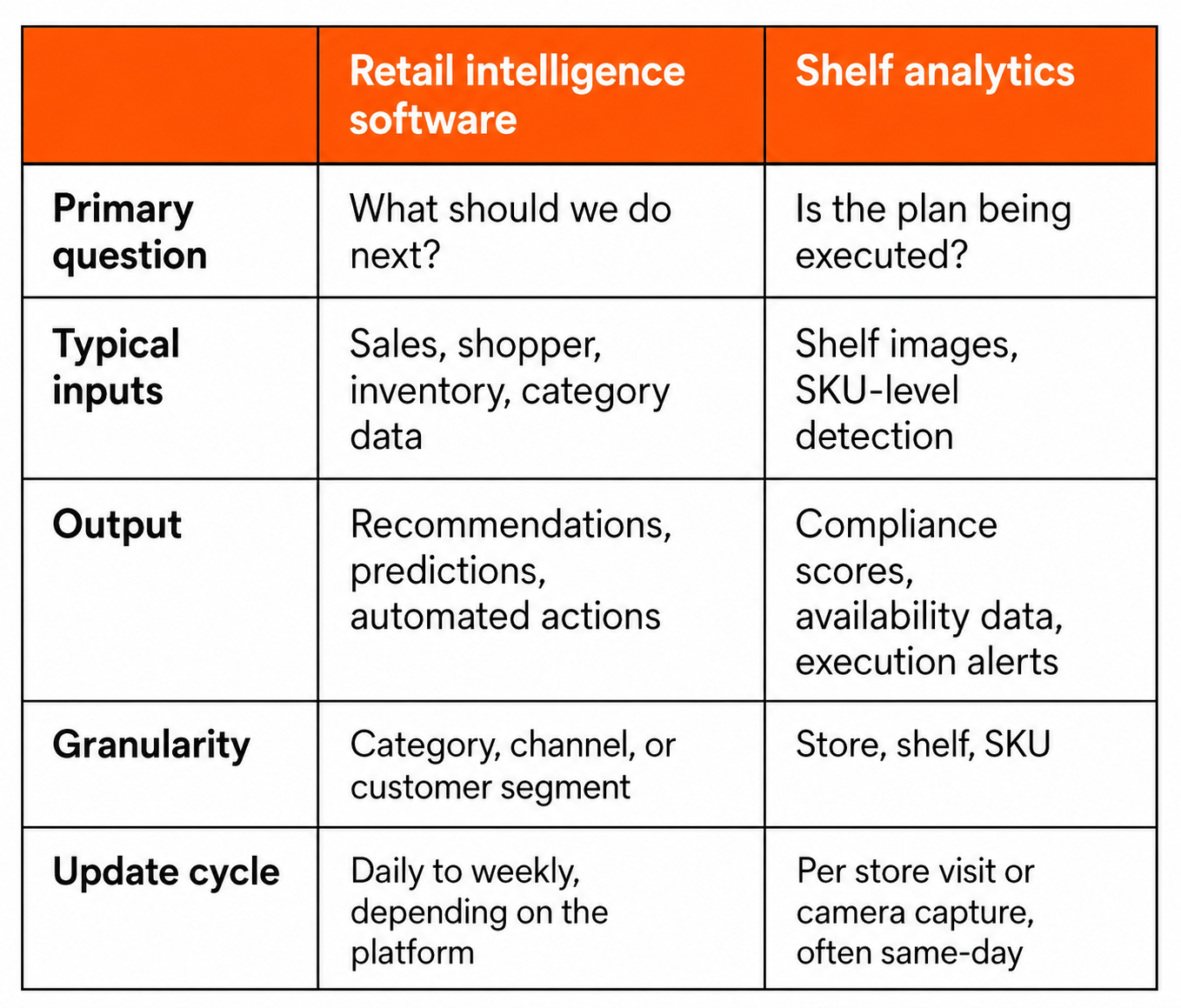
Neither layer replaces the other. A retail intelligence platform without shelf-level execution data is making category and pricing decisions on an assumption that the shelf reflects the plan. Shelf analytics without a retail intelligence layer on top produces accurate execution data with no mechanism to turn it into a category-wide decision. Brands that treat these as competing categories usually end up with a gap somewhere: smart planning with no visibility into whether it happened, or accurate shelf data with no system translating it into the next commercial decision.
Where ShelfWatch Fits
ParallelDots' ShelfWatch is built for the execution layer described above, not as a replacement for retail intelligence software, but as the data source that makes the physical-retail side of that layer reliable.
ShelfWatch uses image recognition to process shelf photos captured by field reps, fixed cameras, or robots, and converts them into structured, store-level data: on-shelf availability, share of shelf versus competitors, planogram compliance, and pricing and promotional accuracy. That data is generated at the SKU level, across every store in a retail network, on a cycle fast enough to catch execution failures while there is still time to correct them, rather than weeks later in a sell-out report.
For a brand running a retail intelligence platform on the category or pricing side, this closes the loop between what the platform recommends and what is actually happening on the shelf. A pricing recommendation only holds if there's a way to confirm the price tag reflects it. A markdown decision only protects margin if the product is actually in stock to sell through. ShelfWatch supplies the ground-truth layer that lets those decisions be verified, corrected, and improved over time, rather than trusted on faith.
ShelfWatch is deployed across 50+ countries, processing shelf images at scale for CPG manufacturers across categories including beverage, personal care, packaged food, and OTC pharmaceuticals.
ShelfWatch integrates with field force apps, SFA systems, and trade promotion tools already in use, so the shelf data surfaces inside existing commercial workflows instead of adding a separate reporting layer for teams to check.
What to Look for When Evaluating Retail Intelligence Software for Physical Retail
For a brand whose retail intelligence needs are rooted in physical stores rather than digital channels, a few questions cut through most vendor positioning faster than a feature list.
- Where does the input data come from, and how often is it refreshed? A platform built on sell-in data or monthly panel data cannot support store-level decisions on a weekly or daily cycle. Ask specifically what feeds the model and how current it is at the point a decision gets made.
- Does it predict and act, or only report? A dashboard that surfaces last month's numbers is retail analytics with a new label. Retail intelligence software should generate a recommendation or trigger an action, not just a chart.
- Does it account for shelf-level execution, or assume it? Most platforms built for assortment, pricing, or promotion decisions do not independently verify whether those decisions are being executed correctly in stores. If a platform doesn't address this, plan to pair it with a shelf analytics layer that does.
- Can the output reach the team that needs to act on it? A recommendation sitting in a separate analytics portal is slower to act on than one that surfaces inside the field force app, SFA system, or trade promotion tool a team already uses daily.
- Is the ROI tied to a decision or to usage? Dashboard logins and report views are not outcomes. Ask for evidence tied to conversion, margin, forecast accuracy, or execution compliance, the metrics that actually move revenue.
None of these questions require a specific vendor answer. They simply separate platforms built to change what a team does next from those built to describe what already happened.
If physical execution is the gap between what your retail intelligence platform recommends and what's actually on the shelf, see what ShelfWatch surfaces in your own stores.
Request a ShelfWatch demo →
Further Reading
→ Share of Shelf: Why It Matters and How to Measure It
→ Planogram Compliance in Retail
→ On-Shelf Availability and Its Business Impact
→ The Complete Guide to Retail Execution and Monitoring
Sources & Citations
Research and Markets – Retail Intelligence Software Market Report
Corsten, D. & Gruen, T.W. – Desperately Seeking Shelf Availability: An Examination of the Extent, the Causes, and the Efforts to Address Retail Out-of-Stocks
Frequently Asked Questions
What is retail intelligence software?
Retail intelligence software unifies data from across a retail business, shopper behaviour, sales, inventory, or in-store execution, and turns it into predictions and actions rather than static reports. It's distinct from standard reporting because it's built to recommend or trigger a decision, not just display one.
Is retail intelligence software the same as retail analytics?
No. Retail analytics is descriptive: it explains what happened across sales, traffic, or shopper behaviour. Retail intelligence software adds prediction and decision support on top of that visibility, so the output is a recommended or automated next step rather than a static report.
Is retail intelligence software the same as shelf analytics?
No, though the two are often used interchangeably. Retail intelligence software is the decision layer, generating recommendations from unified data. Shelf analytics is the execution layer, tracking whether pricing, placement, and availability at the shelf match what was planned. Most brands managing physical retail need both.
Does retail intelligence software require computer vision?
Not necessarily, it depends on which flavour of the category a platform serves. Shopper-side retail intelligence platforms typically run on digital behavioral data. Store-side platforms benefit from computer vision when they need accurate, store-level shelf data to base category and pricing decisions on, since manual audits and sell-in data can't deliver that granularity at scale.
How do I know if I need retail intelligence software or shelf analytics first?
If the immediate problem is understanding shopper behavior, personalizing campaigns, or forecasting demand from existing sales data, retail intelligence software addresses it directly. If the immediate problem is not knowing whether pricing, planograms, or promotions are being executed correctly in stores, shelf analytics is the more direct fix, and it typically feeds a retail intelligence layer built on top of it later.
.png)
.png)