Share it with your network.


For CPG brands, even the best products can fall short at the shelf if execution breaks down. Missing SKUs, misplaced items, and inconsistent promotional displays interrupt product visibility and reduce the chances of a shopper picking up the item. In fact, 25% of sales loss for CPG brands happens inside the store when products are not available or not placed where they should be. These gaps directly impact shelf presence, making it difficult for CPG teams to maintain consistent shelf execution across a large store network
This is where understanding the 5 habits of retail execution becomes essential. Perfect retail execution isn't just a buzzword; it’s the foundation for ensuring your products are visible, accessible, and positioned for maximum impact in stores. With real-time shelf data, brands can make informed decisions on where to focus in-store execution efforts and maintain consistency across hundreds or thousands of locations.
Key Highlights:
- Stronger Shelf Presence: Clear objectives, consistent execution, and accurate placement help CPG brands maintain visibility and reliable product presentation across stores.
- Smarter Prioritization: Focusing on high-impact stores and key SKUs ensures teams direct attention where shelf conditions matter most.
- Data-Driven Accuracy: Using shelf insights, planogram checks, and promotion verification supports precise execution and reduces manual guesswork.
- Continuous Improvement: Ongoing tracking, feedback, and iteration help brands adapt quickly to changing store conditions and sustain consistent retail execution.
What is Retail Execution for CPG Brands?
Retail execution is the process of ensuring that products appear on shelves exactly as planned. For CPG brands, this includes having the right SKUs available, placed correctly, priced accurately, and supported by the correct promotions. Strong retail execution removes guesswork and helps CPG teams act confidently in stores.
Here’s why retail execution matters for CPG brands:
- Ensures Product Visibility: Retail execution ensures your products are stocked, placed correctly, and displayed according to planograms in physical stores. Even top-selling SKUs can be missed without it.
- Drives Consistency Across Stores: Consistent placement, promotional setup, and shelf visibility maintain brand presence across regions and store formats, ensuring your products stand out against competitors.
- Supports Informed Decision-Making: Tracking shelf conditions and planogram compliance gives CPG teams clear, real-time insights to address gaps quickly and maintain strong in-store execution.
- Strengthens Brand Presence: Consistent retail execution helps CPG teams confirm that products are placed correctly on the shelf, making it easier to track how well the brand is represented across stores.
5 Steps to Achieve Perfect Retail Execution
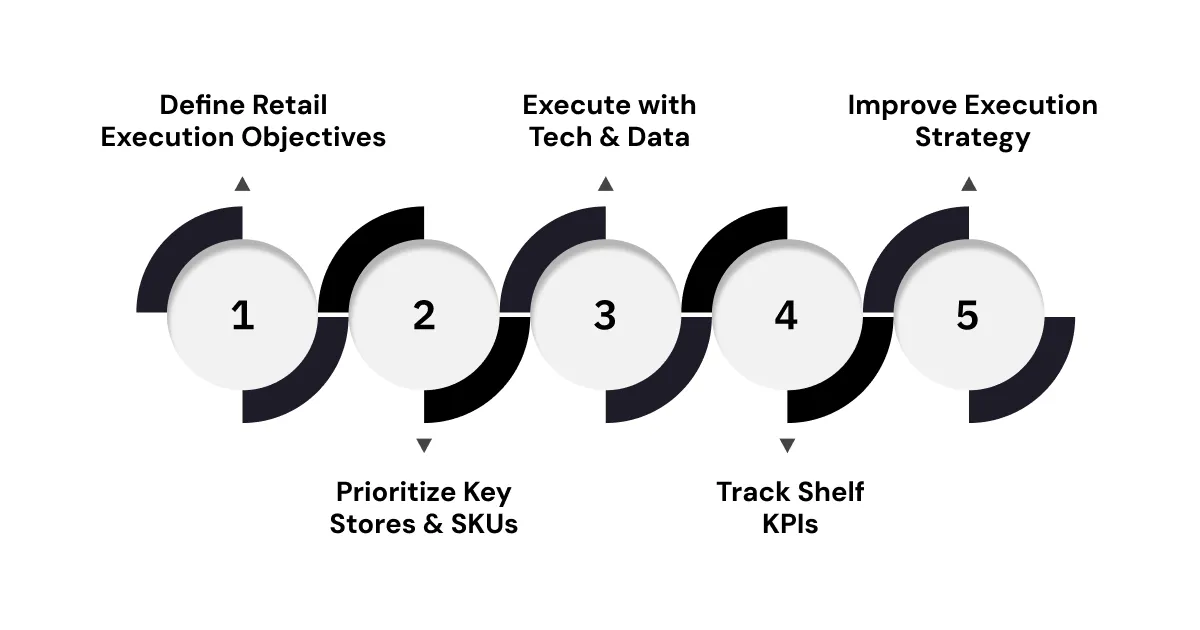
Perfect retail execution is not built in a single day. It needs clear goals, a prioritised approach, accurate shelf visibility, and a mindset focused on continuous improvement.
The following 5 steps give CPG brands a simple, practical path to maintain shelf standards effectively.
Step 1: Define Clear Retail Execution Objectives
CPG brands need to set measurable goals for in-store execution to ensure products are visible and presented correctly. Clear retail shelf execution objectives guide field teams and provide a benchmark to compare actual shelf conditions.
- Objective Clarity: Identify specific outcomes, like keeping top SKUs on the shelf, following the planogram, and setting up promotional displays correctly.
- Measurable Targets: Set numeric targets, such as maintaining minimum facings for top SKUs or deploying promotions in 100% of priority stores.
- Team Alignment: Clearly communicate objectives to sales, marketing, and field staff so everyone knows the priorities for shelf execution.
Well-defined objectives give CPG brands a clear framework for execution. This makes it easier to identify gaps and maintain consistent shelf standards.
Step 2: Prioritize High-Impact Stores and SKUs
Not all stores or products contribute equally to a brand’s shelf visibility. While CPG teams determine which stores and SKUs are most critical, ParallelDots provides the real-time shelf visibility that helps them focus on execution where it matters most.
- Store Prioritization: Identify high-volume or strategically significant stores where shelf execution directly affects visibility and consumer reach.
- SKU Prioritization: Focus on top-selling SKUs, promotional items, and new launches that are crucial for shelf presence and brand representation.
- Focused Field Efforts: By providing accurate shelf data, ParallelDots helps brands ensure field teams concentrate on high-priority stores and SKUs, without suggesting how to allocate resources.
This approach ensures CPG brands maintain consistent in-store execution for the products and stores they identify as high-impact, using shelf visibility insights to guide action.
Step 3: Execute with Precision Using Technology and Data
CPG brands often struggle to maintain consistency in-store because manual observations can miss gaps. Access to accurate, real-time shelf data enables field teams to act with precision and make informed decisions on execution.
- On-Shelf Visibility: Field teams can quickly spot missing SKUs, low facings, or misplacements, ensuring products remain accessible on the shelf.
- Planogram Compliance: Deviations from the intended product layout can be detected early, allowing teams to correct them and uphold brand standards.
- Promotion Verification: Teams can verify that promotional displays, pricing tags, and campaign materials are implemented as planned across priority stores.
By providing reliable shelf-level data, CPG teams are empowered to maintain control over in-store execution, reduce errors, and keep products consistently visible to consumers.
Step 4: Monitor, Measure, and Track Shelf KPIs
Ongoing measurement is critical for CPG brands to understand how well their execution strategy works. Real-time tracking ensures issues are identified early and corrected efficiently.
- On-Shelf Stock Visibility: Track whether SKUs are visible and properly placed on the shelf according to planogram guidelines.
- Share of Shelf Tracking: Assess the brand’s proportion of shelf space in relation to competitors to maintain strong visibility.
- Planogram Compliance: Track adherence to the designated product layout, ensuring facings, placements, and adjacencies meet brand standards.
Monitoring KPIs provides actionable insights that enable CPG brands to address execution gaps proactively and maintain shelf consistency.
Step 5: Iterate and Improve Shelf Execution Strategy
Retail execution is dynamic, and conditions in stores change constantly. CPG teams must continually refine strategies based on shelf-level insights to maintain visibility, compliance, and overall product presentation.
- Analyze Trends: Review shelf data to identify recurring gaps or inconsistencies in execution across stores or SKUs.
- Refine Execution Plans: Use insights from shelf monitoring tools like ParallelDots to adjust field activities, SKU focus, and promotional placement decisions based on what is actually visible on the shelf.
- Continuous Improvement: Update execution strategies to accommodate new launches, seasonal changes, and evolving product placements.
Iteration ensures that CPG brands can adapt to changing store conditions and maintain shelf standards over time, building long-term consistency in retail execution.
Challenges in Implementing Perfect Retail Execution Strategy

Even with strong planning, CPG teams face several obstacles in achieving perfect retail execution. These challenges often arise from the complexity of managing many stores, categories, and SKUs.
Below are some challenges faced by CPG brands in implementing retail execution strategy:
- Limited Visibility Across Stores: Without real-time shelf data, CPG teams rely on manual reports and field checks. This makes it harder to detect missing SKUs or placement issues quickly.
- Inconsistent Planogram Compliance: Products are often misplaced or rearranged in stores. Without monitoring, deviations from the intended layout can go unnoticed, affecting shelf presentation and brand visibility.
- Delayed Issue Detection: Stock gaps or incorrect displays may go unnoticed for days or weeks. Slow detection leads to missed sales opportunities and ineffective promotions.
- High Workload for Field Teams: Manual store audits take significant time and effort. Teams may spend more time collecting data than taking corrective action, reducing efficiency.
- Difficulty Scaling Execution: Maintaining consistent execution across regions and store formats is challenging without standardised KPIs and automated shelf insights.
Understanding these challenges creates a foundation for more effective strategies supported by reliable shelf data.
How ParallelDots Can Enhance Retail Execution?
ParallelDots supports CPG retail execution by providing real-time shelf visibility across physical stores. Its image recognition technology helps brands detect execution gaps quickly and take targeted action.
Here’s how we can assist you:
- Real-Time On-Shelf Stock Visibility: ParallelDots identifies which SKUs are physically present on the shelf and highlights any stock gaps at the shelf level. This helps field teams address missing products promptly during store visits.
- Accurate Share of Shelf Tracking: Using advanced computer vision, ParallelDots measures share of shelf with precision. This allows CPG teams to understand how their products occupy shelf space compared to competing brands. Accurate share of shelf data helps ensure key SKUs receive the visibility they need for effective retail execution.
- Planogram Compliance Monitoring: ParallelDots detects placement deviations as soon as images are captured. Field teams can use these insights to correct placement issues during store visits, improving execution accuracy and ensuring products appear as planned.
- Promotion and Pricing Verification: ParallelDots helps CPG teams confirm that promotional materials, displays, and shelf signage are in place as intended. This ensures that in-store campaigns are executed correctly without implying pricing strategy adjustments.
- Actionable Insights for Field Teams: ParallelDots delivers clear, actionable shelf data, enabling field teams to focus on areas that require attention. Rather than relying on manual checks, teams can prioritise their efforts using the insights provided, making each store visit more efficient.
By providing reliable shelf data at scale, ParallelDots empowers CPG brands to maintain consistent, accurate, and effective in-store execution.
Take the next step to elevate your retail execution. Request a demo today.
Frequently Asked Questions
1. What tools or technologies support accurate retail data collection?
Accurate retail data collection relies on tools that capture shelf-level information in physical stores. Solutions like mobile apps for field teams and cloud-based reporting platforms help track on-shelf stock levels, monitor planogram compliance, and measure share of shelf in real time. AI-powered image recognition further enhances accuracy, ensuring CPG brands can see exactly how their products are placed and displayed on shelves.
2. What metrics should be tracked to measure retail execution effectiveness?
Key metrics include on-shelf availability, product placement compliance, promotional display adherence, and planogram compliance. These are the metrics ParallelDots monitors, providing CPG brands with accurate, real-time shelf data. Tracking these indicators helps identify gaps, ensure products are placed correctly, and give visibility into in-store execution, without implying direct improvement in sales or business outcomes.
3. How can image recognition and AI improve execution accuracy?
Image recognition with ParallelDots helps detect shelf conditions, identify out-of-stock products, and track planogram compliance. By providing real-time shelf data, it supports CPG sales teams in spotting misplaced items and monitoring execution accuracy, without implying full automation of store processes.
4. How should feedback from field teams be integrated into the process?
Field team feedback should be systematically collected via mobile apps or reporting platforms and analyzed alongside real-time shelf data. Combining their observations with shelf-level insights helps CPG brands identify stock gaps, planogram deviations, and promotional execution issues more accurately, enabling better-informed decisions for in-store retail execution.
5. What post-execution steps help identify improvement opportunities?
Post-execution steps include analyzing compliance reports, comparing planned versus actual execution, identifying gaps, and gathering field insights. Continuous monitoring and reviewing results help teams understand patterns, address execution issues, and make informed adjustments for future retail execution.
.png)
.png)