Shelf Monitoring

On-Shelf Availability: Why Products Go Missing at the Shelf

Vriddhi Bhagat
February 25, 2026
5
mins read
Ready to get Started?
request A Demo

Most retail and CPG teams plan for availability. Inventory is tracked carefully. Replenishment cycles are defined. Systems report products as in stock. And yet, availability keeps surfacing as a problem, often only after performance slips.

The issue usually isn’t supply. It’s that on-shelf availability fails quietly.

A product doesn’t need to be out of stock to be unavailable. It only needs to be missing from the shelf when a shopper looks for it. When that happens, the loss is immediate, and it rarely leaves a clear trace. No alert fires. No system captures the moment. The opportunity simply passes.

If you manage execution across multiple stores, this pattern is familiar. Performance varies by location. Categories underperform without a clear explanation. Teams debate whether the issue sits in demand, replenishment, or execution - without a reliable way to see where the breakdown actually occurred.

This is the reality of on-shelf availability in modern retail. Not a single failure point, but a series of small execution gaps that compound over time.

This guide looks at on-shelf availability as a shelf-level execution outcome, not an inventory metric. We’ll explore why OSA breaks after products reach the store, why those failures are difficult to detect, and what changes when availability is grounded in real shelf conditions rather than assumptions.

Key Takeaways

  • On-shelf availability reflects shelf reality, not system assumptions.
  • Inventory availability and shelf availability diverge more often than most teams expect.
  • Most OSA failures occur inside the store, after products are delivered.
  • Traditional systems infer availability instead of verifying it.
  • Seeing the shelf changes how availability is understood and managed.
Comparison of inventory availability versus on-shelf availability in retail.

On-Shelf Availability vs Inventory Availability

Inventory availability answers one question: Is the product present in the store or supply chain?
On-shelf availability answers a different one: Is the product on the shelf right now, where the shopper expects to find it?
In day-to-day operations, these two are often treated as interchangeable. In practice, they separate more often than teams assume.

A product can be:

  • Delivered on time
  • Counted accurately in inventory
  • Marked as available in systems

…and still be missing from the shelf due to delayed replenishment, incomplete restocking, or local execution decisions.
This gap is where many retail stockouts actually occur—not because supply failed, but because execution didn’t hold.

Why This Distinction Matters

Most retail systems are built to track movement—shipments, receipts, and sales. They implicitly assume that once a product reaches the store, execution follows.
But shelf execution isn’t automatic. It depends on people, priorities, timing, and local conditions that vary from store to store.
When availability is inferred from inventory signals alone, shelf-level failures remain hidden. The system believes the product is available. The shopper experiences the opposite.
That disconnect sits at the core of most on-shelf availability problems.
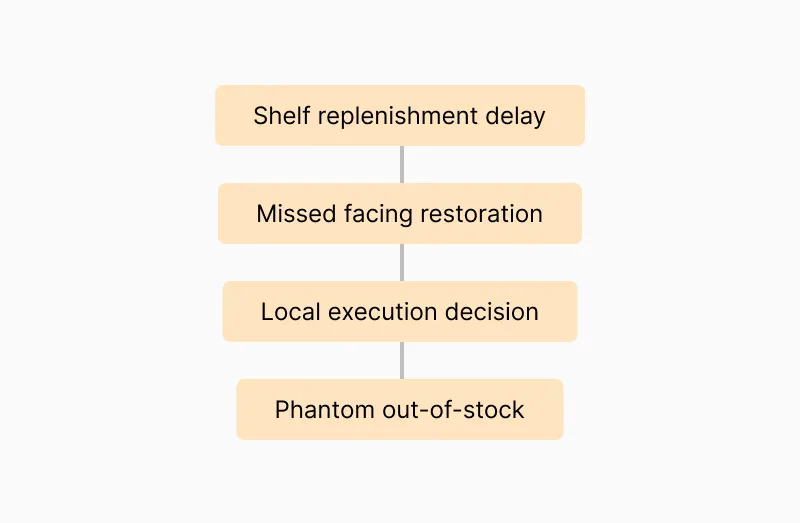
Illustration showing how small shelf execution gaps lead to on-shelf availability failures.

Why On-Shelf Availability Breaks in Retail

On-shelf availability rarely fails because of a single, visible breakdown. More often, it erodes because nothing is consistently validating that execution is holding.
In a single store, availability issues are usually visible and correctable. Across large store networks, they scale quietly.
So why does this break at scale?

Execution Drift Inside the Store

Once a product reaches the store, a series of small decisions determines whether it stays available:

  • When shelves are replenished
  • Whether facings are fully restored
  • How temporary stockouts are handled
  • What happens when labor is constrained or priorities shift

Each decision introduces minor variation. On its own, that variation seems manageable. Across hundreds or thousands of stores, it compounds.
Shelves don’t suddenly fall into disorder. They drift—slowly, unevenly, and often unnoticed.

Availability Is Inferred, Not Verified

Most retailers don’t measure on-shelf availability directly. Instead, they infer it from-

  • Inventory counts
  • Sales movement
  • Periodic manual audits

These signals describe what should be happening. They don’t confirm what is happening.
Shelf conditions change constantly between audits. When they do, those changes usually go unobserved. Products remain “available” in reports while being absent from the shelf for hours- or days.
This is how phantom out-of-stocks persist without triggering alarms.

Why Failures Stay Invisible

OSA failures rarely show up as clear exceptions because no single system owns shelf reality. By the time performance issues surface in reports, the shelf condition that caused them has often already changed.
What remains is a lagging indicator, stripped of context.
This is why on-shelf availability is so often discussed after promotions underperform or categories miss targets- rather than managed proactively as execution unfolds.

The Business Impact of Poor On-Shelf Availability

The cost of poor on-shelf availability isn’t abstract. It shows up where it matters most.

Lost Sales Happen at the Shelf

When a shopper can’t find a product, the response is immediate:

  • They switch brands
  • They delay the purchase
  • Or they leave the category altogether

These decisions happen in seconds. They don’t wait for replenishment cycles or reports.

Brand Trust Erodes Quietly

Repeated availability failures shape shopper behavior over time. Shoppers stop expecting certain products to be there. They stop looking. Basket size shrinks- not dramatically, but consistently.
This erosion rarely appears as a single metric. It accumulates quietly.

Why the Impact Is Hard to Pin Down

Most lost sales from poor OSA don’t register as explicit stockouts. They surface as:

  • Uneven store-level performance
  • Softer category results
  • Promotions that don’t deliver as expected

By the time these patterns are visible, the shelf conditions that caused them are long gone.

Smarter Shelves. Clearer Availability.
When availability gaps are invisible, execution becomes guesswork. See how shelf-level visibility helps teams detect issues early and focus attention where it matters most.
Explore How →

How AI Detects On-Shelf Availability Gaps

At its core, the OSA challenge is a visibility problem. You can’t manage what you can’t see.

From Assumption to Observation

AI changes how availability is measured by grounding it in actual shelf conditions.
Using shelf images captured through cameras, mobile audits, or similar methods, AI systems can:

  • Identify missing SKUs
  • Detect empty or partially empty facings
  • Surface shelf-level stockouts
  • Flag phantom out-of-stocks

This shifts availability from something inferred to something observed.

Detection vs Prediction

Traditional approaches focus heavily on predicting stockouts based on historical patterns. Prediction supports planning. It doesn’t validate execution.
AI-based OSA detection answers a simpler, more immediate question: Is the product on the shelf right now?
That distinction matters. Prediction estimates risk. Detection reveals reality.

Why This Matters Operationally

When shelf conditions are observed continuously, availability stops being a retrospective discussion. It becomes an execution variable teams can actually respond to—store by store, category by category.
On-shelf availability doesn’t break because retail teams fail to plan. It breaks because shelf execution isn’t continuously visible.
Inventory systems track movement. Reports summarize outcomes. Neither sees the shelf.
As long as availability is inferred rather than observed, execution gaps remain hidden- and lost sales remain difficult to explain.
When retailers ground OSA in real shelf conditions, availability shifts from a retrospective metric to an operational discipline. And the shelf becomes what it should be: the place where strategy either materializes or quietly doesn’t.

See What’s Really Happening on the Shelf.
On-shelf availability only improves once shelf conditions are visible and measurable. Explore how leading retail and CPG teams use real shelf data to identify availability gaps, prioritise action, and protect sales at scale.
Explore Shelf Visibility →

Most retail and CPG teams plan for availability. Inventory is tracked carefully. Replenishment cycles are defined. Systems report products as in stock. And yet, availability keeps surfacing as a problem, often only after performance slips.

The issue usually isn’t supply. It’s that on-shelf availability fails quietly.

A product doesn’t need to be out of stock to be unavailable. It only needs to be missing from the shelf when a shopper looks for it. When that happens, the loss is immediate, and it rarely leaves a clear trace. No alert fires. No system captures the moment. The opportunity simply passes.

If you manage execution across multiple stores, this pattern is familiar. Performance varies by location. Categories underperform without a clear explanation. Teams debate whether the issue sits in demand, replenishment, or execution - without a reliable way to see where the breakdown actually occurred.

This is the reality of on-shelf availability in modern retail. Not a single failure point, but a series of small execution gaps that compound over time.

This guide looks at on-shelf availability as a shelf-level execution outcome, not an inventory metric. We’ll explore why OSA breaks after products reach the store, why those failures are difficult to detect, and what changes when availability is grounded in real shelf conditions rather than assumptions.

Key Takeaways

  • On-shelf availability reflects shelf reality, not system assumptions.
  • Inventory availability and shelf availability diverge more often than most teams expect.
  • Most OSA failures occur inside the store, after products are delivered.
  • Traditional systems infer availability instead of verifying it.
  • Seeing the shelf changes how availability is understood and managed.
Comparison of inventory availability versus on-shelf availability in retail.

On-Shelf Availability vs Inventory Availability

Inventory availability answers one question: Is the product present in the store or supply chain?
On-shelf availability answers a different one: Is the product on the shelf right now, where the shopper expects to find it?
In day-to-day operations, these two are often treated as interchangeable. In practice, they separate more often than teams assume.

A product can be:

  • Delivered on time
  • Counted accurately in inventory
  • Marked as available in systems

…and still be missing from the shelf due to delayed replenishment, incomplete restocking, or local execution decisions.
This gap is where many retail stockouts actually occur—not because supply failed, but because execution didn’t hold.

Why This Distinction Matters

Most retail systems are built to track movement—shipments, receipts, and sales. They implicitly assume that once a product reaches the store, execution follows.
But shelf execution isn’t automatic. It depends on people, priorities, timing, and local conditions that vary from store to store.
When availability is inferred from inventory signals alone, shelf-level failures remain hidden. The system believes the product is available. The shopper experiences the opposite.
That disconnect sits at the core of most on-shelf availability problems.

Illustration showing how small shelf execution gaps lead to on-shelf availability failures.

Why On-Shelf Availability Breaks in Retail

On-shelf availability rarely fails because of a single, visible breakdown. More often, it erodes because nothing is consistently validating that execution is holding.
In a single store, availability issues are usually visible and correctable. Across large store networks, they scale quietly.
So why does this break at scale?

Execution Drift Inside the Store

Once a product reaches the store, a series of small decisions determines whether it stays available:

  • When shelves are replenished
  • Whether facings are fully restored
  • How temporary stockouts are handled
  • What happens when labor is constrained or priorities shift

Each decision introduces minor variation. On its own, that variation seems manageable. Across hundreds or thousands of stores, it compounds.
Shelves don’t suddenly fall into disorder. They drift—slowly, unevenly, and often unnoticed.

Availability Is Inferred, Not Verified

Most retailers don’t measure on-shelf availability directly. Instead, they infer it from-

  • Inventory counts
  • Sales movement
  • Periodic manual audits

These signals describe what should be happening. They don’t confirm what is happening.
Shelf conditions change constantly between audits. When they do, those changes usually go unobserved. Products remain “available” in reports while being absent from the shelf for hours- or days.
This is how phantom out-of-stocks persist without triggering alarms.

Why Failures Stay Invisible

OSA failures rarely show up as clear exceptions because no single system owns shelf reality. By the time performance issues surface in reports, the shelf condition that caused them has often already changed.
What remains is a lagging indicator, stripped of context.
This is why on-shelf availability is so often discussed after promotions underperform or categories miss targets- rather than managed proactively as execution unfolds.

The Business Impact of Poor On-Shelf Availability

The cost of poor on-shelf availability isn’t abstract. It shows up where it matters most.

Lost Sales Happen at the Shelf

When a shopper can’t find a product, the response is immediate:

  • They switch brands
  • They delay the purchase
  • Or they leave the category altogether

These decisions happen in seconds. They don’t wait for replenishment cycles or reports.

Brand Trust Erodes Quietly

Repeated availability failures shape shopper behavior over time. Shoppers stop expecting certain products to be there. They stop looking. Basket size shrinks- not dramatically, but consistently.
This erosion rarely appears as a single metric. It accumulates quietly.

Why the Impact Is Hard to Pin Down

Most lost sales from poor OSA don’t register as explicit stockouts. They surface as:

  • Uneven store-level performance
  • Softer category results
  • Promotions that don’t deliver as expected

By the time these patterns are visible, the shelf conditions that caused them are long gone.

Smarter Shelves. Clearer Availability.
When availability gaps are invisible, execution becomes guesswork. See how shelf-level visibility helps teams detect issues early and focus attention where it matters most.
Explore How →

How AI Detects On-Shelf Availability Gaps

At its core, the OSA challenge is a visibility problem. You can’t manage what you can’t see.

From Assumption to Observation

AI changes how availability is measured by grounding it in actual shelf conditions.
Using shelf images captured through cameras, mobile audits, or similar methods, AI systems can:

  • Identify missing SKUs
  • Detect empty or partially empty facings
  • Surface shelf-level stockouts
  • Flag phantom out-of-stocks

This shifts availability from something inferred to something observed.

Detection vs Prediction

Traditional approaches focus heavily on predicting stockouts based on historical patterns. Prediction supports planning. It doesn’t validate execution.
AI-based OSA detection answers a simpler, more immediate question: Is the product on the shelf right now?
That distinction matters. Prediction estimates risk. Detection reveals reality.

Why This Matters Operationally

When shelf conditions are observed continuously, availability stops being a retrospective discussion. It becomes an execution variable teams can actually respond to—store by store, category by category.
On-shelf availability doesn’t break because retail teams fail to plan. It breaks because shelf execution isn’t continuously visible.
Inventory systems track movement. Reports summarize outcomes. Neither sees the shelf.
As long as availability is inferred rather than observed, execution gaps remain hidden- and lost sales remain difficult to explain.
When retailers ground OSA in real shelf conditions, availability shifts from a retrospective metric to an operational discipline. And the shelf becomes what it should be: the place where strategy either materializes or quietly doesn’t.

See What’s Really Happening on the Shelf.
On-shelf availability only improves once shelf conditions are visible and measurable. Explore how leading retail and CPG teams use real shelf data to identify availability gaps, prioritise action, and protect sales at scale.
Explore Shelf Visibility →