Share it with your network.


A compliance score of 87% looks clean on a dashboard. What it doesn't show is which 13% of your SKUs are out of position, across which 340 stores, or whether the same locations are failing week after week. The number exists. The context doesn't. And by the time a field team verifies it, the shelf has been reset twice.
The gap between the compliance score and the shelf reality isn't a data problem. It's a pipeline problem. Most category managers receive an output - a number, a flag, a consolidated report - without understanding the six steps that produced it. That makes the output hard to interrogate when something looks wrong and easy to over-trust when it looks right.
This piece traces those six steps: from the moment a field rep photographs a shelf to the moment a category manager sees a compliance alert they can act on. Understanding the mechanism doesn't make the data perfect. It makes the data useful.
Key Takeaways
- The six steps each fail differently: Image capture, object detection, SKU identification, planogram overlay, exception flagging, data output - accuracy issues in the output almost always trace back to one specific step, not the system as a whole.
- New SKU launch lag is a pipeline dependency, not a bug: Until a new product's packaging is in the recognition database, the system cannot identify it, creating a compliance data blind spot from launch date until the update is made.
- "Real-time" means same-day, not continuous: Images process at defined scan intervals and exceptions return the same day - sufficient for most category execution decisions.
- A 95% accuracy rate is a decision threshold, not a margin of error: The comparison that matters is 95% AI accuracy at visit frequency versus manual field audits that cover a fraction of your store estate each quarter, inconsistently.
- The pipeline ends at data output; execution begins after it: What the category team does with the signal, and how fast, is what determines whether shelf image recognition changes the shelf or only describes it.
Shelf Image Recognition Is a Six-Step Pipeline, Not a Single Processing Moment
Every industry description simplifies this to "AI reads the shelf and produces data." That's accurate in the same way that "a car converts fuel into movement" is accurate. True, not useful.
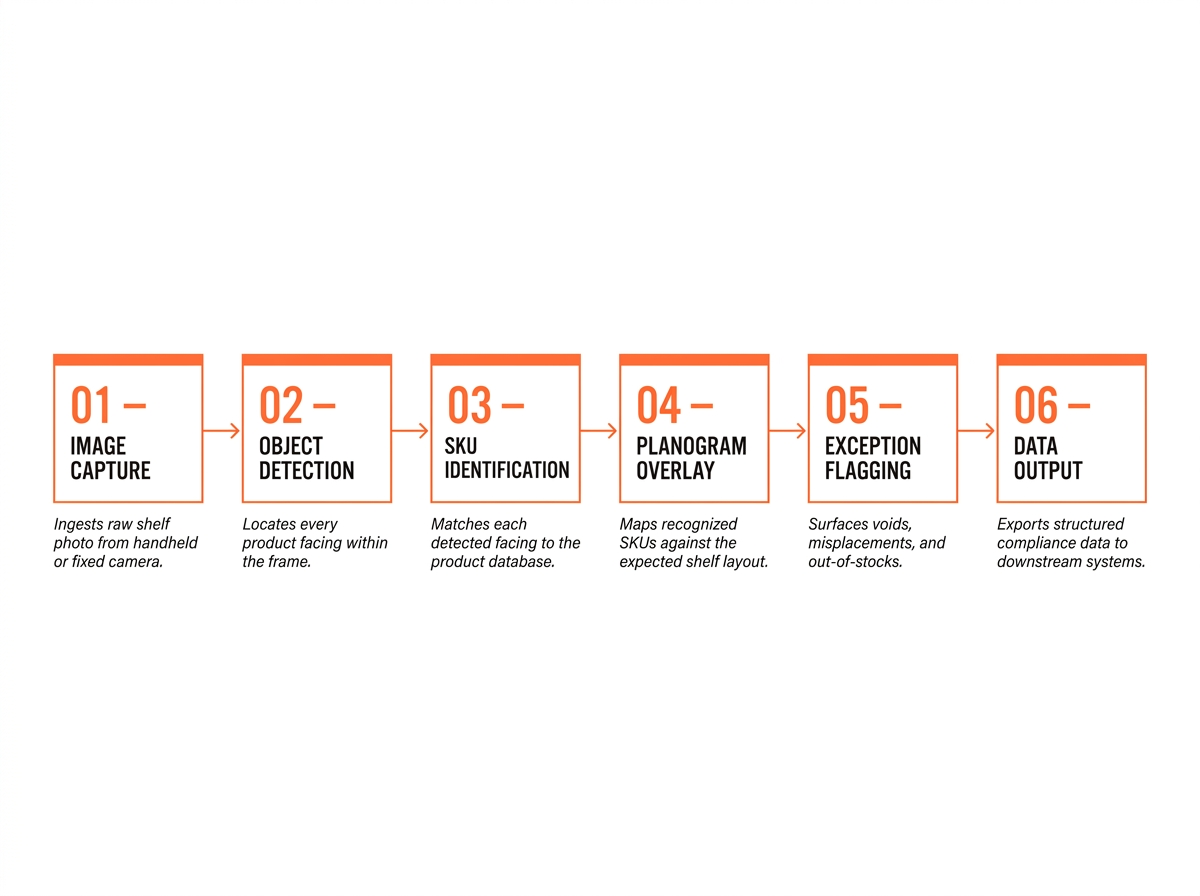
The pipeline has six steps. Understanding what happens at each one matters because that's where errors originate, latency accumulates, and data quality decisions get made.
Step 1 - Image capture. A field rep photographs the shelf with a mobile device, or a fixed in-store camera captures on a scheduled interval. Lighting, angle, and proximity affect the quality of everything that follows. Field team turnover is the hidden variable - a rep who learned the protocol six months ago photographs differently from one on their second week.
Step 2 - Object detection. The AI locates every product facing in the image frame. It finds where products are, not which products they are. Dense shelves and partially obstructed facings introduce detection gaps here.
Step 3 - SKU identification. Detected objects are matched against a product database. This is where recognition accuracy is determined, and where new SKU launch lag lives. A product that hit shelves last week cannot be identified until its packaging imagery is added to the database. That is not a failure state; it is a pipeline dependency that requires active management.
Step 4 - Planogram overlay. Identified SKUs are mapped against the approved layout. The system computes the delta between actual shelf state and intended position.
Step 5 - Exception flagging. Deviations that exceed configured thresholds trigger alerts. A brand can set different compliance tolerances for a flagship SKU versus a tail item; this is where that calibration happens.
Step 6 - Data output. Structured compliance data leaves the pipeline as a report, alert, or dashboard feed. This is the only step the category manager typically sees.
The friction most teams encounter - wrong compliance scores, missed out-of-stocks, SKUs flagged as non-compliant when the shelf looked fine - usually traces back to one specific step. Step 3 for new launches. Step 5 for misconfigured thresholds. Step 1 for stores where image quality is inconsistent.
What is shelf image recognition?
Shelf image recognition - an AI process that analyses images of physical retail shelves to identify which products are present, where they are positioned, and whether they match the approved planogram layout, producing structured compliance data including facing counts, out-of-stock flags, and share-of-shelf percentages from a single photograph.
How does shelf image recognition work in real time?
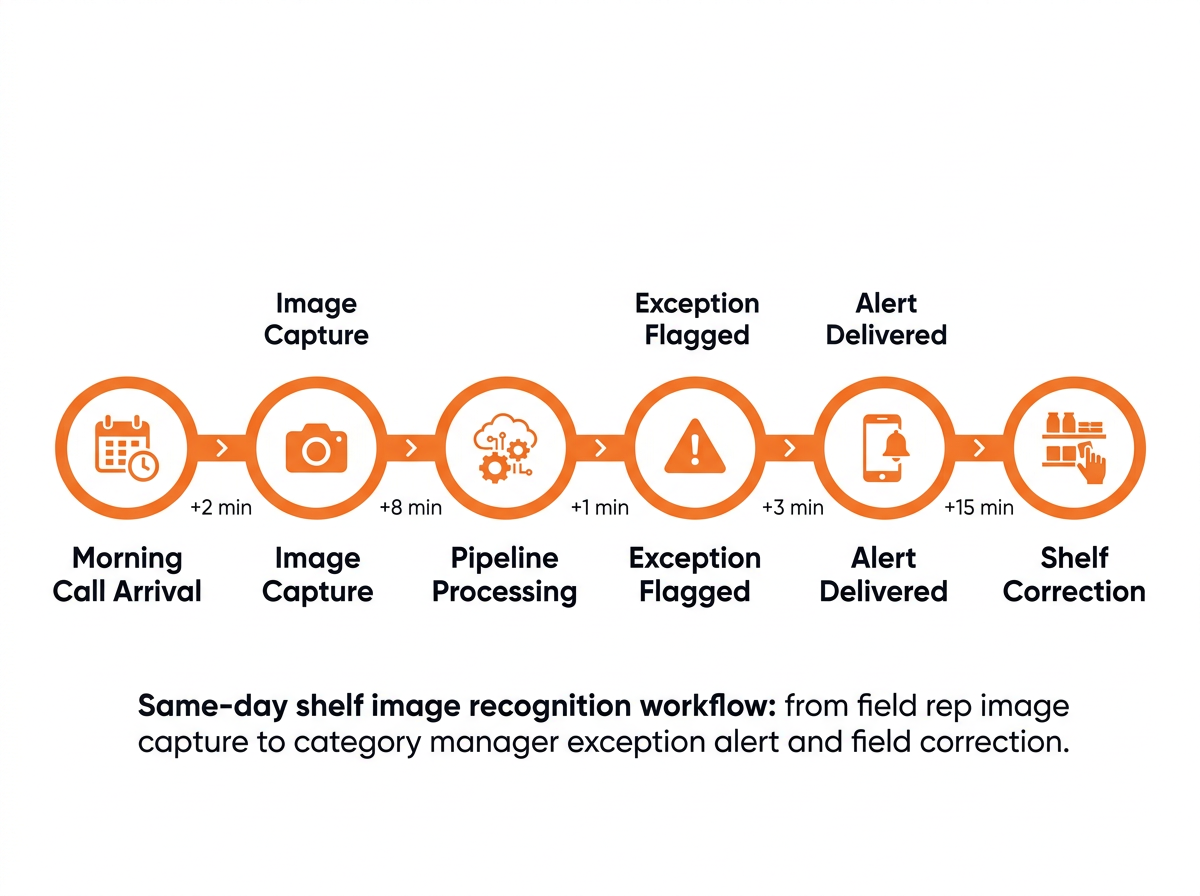
Shelf image recognition in real time - the sequential processing of store images through a detection and identification pipeline that surfaces compliance exceptions - facing deviations, out-of-stocks, planogram mismatches - within the same day as image capture, enabling field teams to act on specific SKU-level alerts before leaving a store.
How Shelf Image Recognition Enables Real-Time Shelf Monitoring - and What "Real-Time" Actually Means in a Store
"Real-time" is one of the most overloaded terms in retail technology. It usually means "faster than the previous process," which can mean anything from a 30-second latency to a 48-hour improvement over a paper audit form.
In shelf image recognition, real-time means something specific: images are processed at defined scan intervals, and exceptions are returned the same day. That is operationally real-time for a category manager deciding which stores to prioritise for a next-day field correction. It does not mean continuous video monitoring of every aisle.
That distinction matters for managing expectations with regional managers who want to know why a compliance alert fired at 2pm when the shelf deviation apparently happened at 10am. The scan interval is the unit of time this system works in. Not the second. Not the minute.
Out-of-stock detection illustrates the mechanism clearly. When Step 2 (object detection) finds a gap where the planogram requires a facing, the system flags an out-of-stock event. It does not know why the shelf is empty - whether it's a replenishment failure, a phantom inventory discrepancy, or something else entirely. The image recognition pipeline reports the condition. The field team investigates the cause.
Promotional execution monitoring works the same way. When a brand activates a temporary promotional planogram - a secondary display, a feature end-cap, a cross-merchandise fixture - the overlay in Step 4 compares against the promotional layout, not the base planogram. Compliance monitoring continues through the promotional period without requiring a manual reconfiguration of the audit criteria.
The shelf at 9am and the shelf at 4pm are two different things. Shelf image recognition, at visit-triggered scan frequency, captures one of them. Knowing which one you captured is part of interpreting the output correctly.
How can retailers monitor shelf accuracy in real time?
Monitoring shelf accuracy in real time - deploying shelf image recognition at defined scan intervals across store locations so that each image processed through the detection and compliance pipeline surfaces facing deviations, out-of-stock events, and planogram mismatches as separate exception types routed to field teams and category managers within the same day as capture.
What a 95% SKU Accuracy Rate Actually Means for the Number on Your Dashboard
The question category managers actually need answered is not "what does 95% accuracy cost?" It is "is 95% accurate enough to act on?" The answer depends entirely on what you are comparing it to.
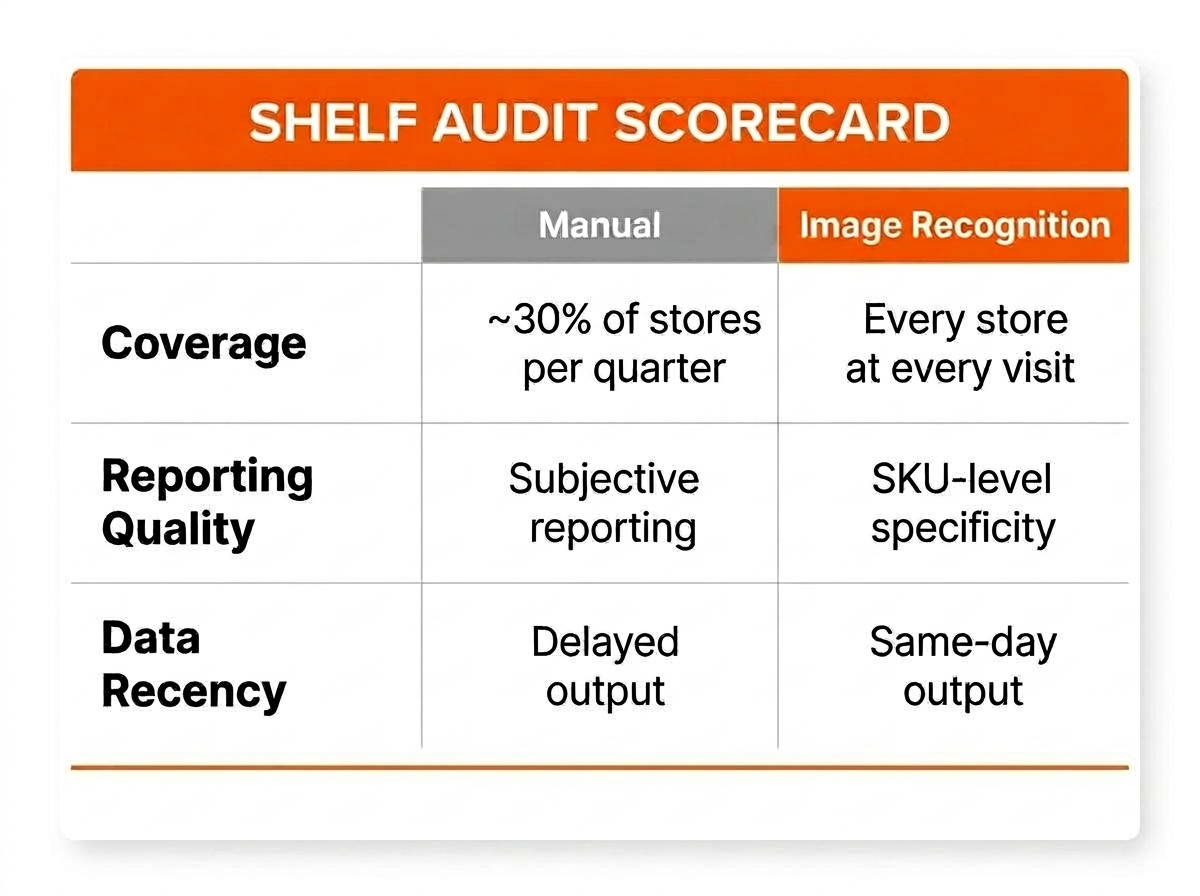
Manual field audits - the status quo for most shelf monitoring programmes - deliver coverage of a fraction of the store estate per quarter, completed by reps whose reporting quality varies with training recency, time pressure, and call plan load. The data is subjective, inconsistently captured, and old by the time it reaches a dashboard. The benchmark is not 95% AI accuracy versus perfect data. It is 95% AI accuracy at visit frequency versus sparse, variable human reporting four times a year.
At 95% accuracy, the compliance trends that emerge across multiple store visits are robust enough to drive decisions. A store flagging the same deviation across six consecutive visits is delivering a reliable signal - not noise, not an artefact, but a shelf problem that warrants a field correction. The value of visit-frequency data is that patterns confirm themselves quickly.
This is also where on-shelf availability and planogram compliance carry different tolerances from the same pipeline. An out-of-stock flag from Step 2 does not require correct SKU identification - object detection found nothing where something should be, and that signal holds regardless of which product was supposed to fill the gap. A planogram compliance failure does require correct SKU identification at Step 3. Knowing which signal type you are acting on tells you how much weight to place on it.
ParallelDots' ShelfWatch commits to 95% SKU-level accuracy as a service-level guarantee, not a best-case estimate. At that threshold, the compliance score on a category manager's dashboard reflects actual shelf state closely enough to direct a field correction without a manual validation step for every exception. Exception-driven store calls become targeted rather than speculative.
What data does shelf image recognition capture from a retail shelf?
Shelf image recognition data - facing-level information for every product detected in a shelf photograph, including SKU identity, facing count, position relative to the planogram, share-of-shelf percentage against actual competitor presence, out-of-stock gaps, promotional label compliance, and product orientation, all derived from a single image without additional sensor input.
How accurate is AI-based shelf image recognition?
AI-based shelf image recognition accuracy - measured at the SKU identification step as the percentage of detected facings correctly matched to the right product in the database. At 95% accuracy, compliance trends across multiple store visits are reliable enough to direct field corrections without manual validation of every exception. The meaningful benchmark is not accuracy against perfect data, but accuracy at visit frequency against manual audit programmes that cover a fraction of stores each quarter with variable reliability.
Five Questions Category Managers Ask Before They Act on Shelf Image Recognition Data
Getting data from a new system and actually trusting it are two different timelines. These are the questions that reliably surface in the first 90 days.
What is shelf image recognition? Shelf image recognition is the layer between a field rep's camera and a category manager's compliance dashboard - it converts a shelf photograph into structured execution data that's available the same day. Unlike inventory systems, which infer shelf state from replenishment records, shelf image recognition confirms what is physically present at SKU-level granularity, which is the only way to detect phantom inventory, facing drift, or competitor encroachment that upstream data sources never register.
How does shelf image recognition work in real time? Real-time means images captured during store visits or scheduled sweeps are processed and exceptions are available the same day - not via continuous live feed. A field rep photographing a shelf at 10am can receive a prioritised list of specific SKU deviations before their next call, without waiting for a consolidated weekly report to surface a shelf problem that's already been sitting there for five days.
What data does shelf image recognition capture from a retail shelf? A single shelf image can return 15–20 structured data points per image - SKU identity, facing count, planogram position, share-of-shelf against actual competitor presence, out-of-stock gaps, and promotional compliance status. That data routes to three levels: field reps receive SKU-level correction tasks, regional managers see store-pattern views, and category managers get execution data connected to category strategy decisions rather than a flat list of individual store flags.
How accurate is AI-based shelf image recognition? The accuracy rate matters differently depending on what you're measuring. Out-of-stock detection at Step 2 doesn't require correct SKU identification to be valid - object detection found a gap where a facing should be, and that signal holds regardless of which SKU was supposed to be there. Planogram compliance scoring at Steps 3–4 does require correct SKU identification, which means your OSA data and your compliance score carry different accuracy tolerances from the same pipeline.
How can retailers monitor shelf accuracy in real time? Shelf accuracy monitoring works through a three-tier exception routing structure: field reps receive same-day alerts on specific SKU deviations while still in store, regional managers see compliance patterns emerging across locations, and category managers receive execution data aggregated against category targets. The system directs a field rep to a precise shelf position - not a store-level flag - which is the operational difference between an alert that gets acted on the same day and one that sits in a report until the next quarterly review.
The Six Steps Are Standard. What Happens After Step Six Is Not.
The pipeline described in this post is largely consistent across enterprise shelf image recognition providers. The architecture - detect, identify, overlay, flag, output - is not the differentiator it was three years ago.
What differentiates execution is what happens after Step 6. How quickly does a field team receive the exception? How clearly is it prioritised against everything else in their call plan? Does the category manager see a compliance trend across 200 stores, or a list of 200 individual flags that each require interpretation?
The gap between what the shelf is and what the data says it is - that's the problem the pipeline solves. The gap between what the data says and what the shelf becomes - that's the problem the category team owns.
.png)
.png)
.png)