Share it with your network.


You can score every SKU, get sign-off from finance, negotiate the delistings with buyers, and file the updated planogram - and still find the cut products sitting on the shelf three weeks later across 200 stores. The decision was right. The shelf disagreed.
This is the standard failure, not the unusual one. Every major SKU rationalization framework ends at the portfolio decision: which products to cut, which to keep, which to consolidate. None of them cover what happens next - whether cut products were actually removed from shelves, whether surviving SKUs got the shelf space they earned, and whether the shelf after the reset reflects the plan at all.
This article covers the part of the product SKU analysis methodology most guides leave out: the three steps between the portfolio decision and the actual shelf outcome, why those steps matter as much as the cut decisions themselves, and what you're really measuring when you skip them and results come in flat.
Key Takeaways
- Every rationalization framework stops at the same place: You get a cut list. No one tells you how to check it actually happened on the shelf.
- The execution gap has three parts: Did cut products leave the shelf? Did surviving SKUs get the right facings? Are must-stock items staying in stock? Syndicated data won't tell you for weeks.
- Buyer agreements don't guarantee store execution: A planogram reset agreed centrally can still execute inconsistently across 200+ stores.
- Syndicated data runs 3–4 weeks behind: A rationalization executed in week one won't show up in your performance reports until week five or six.
- Closing the gap changes your next cycle: Category managers with verified execution data enter the next buyer review with evidence - not inferences from sell-in records.
Every Major SKU Rationalization Framework Stops Before the Shelf Gets Involved
SKU rationalization in CPG is how brands decide which products earn their shelf space and which get cut, consolidated, or repositioned. It sits across category management, supply chain, and commercial strategy - and it has some of the most well-developed analytical frameworks in the industry behind it.
The main ones are worth naming. ABC analysis ranks products by revenue contribution and targets the slow-moving tail. Bain's Incremental Profit Pool Velocity (IPPV) model goes further - it asks whether a product is driving new revenue for the brand or just taking sales away from other items in the same portfolio. McKinsey's SKU Health Card scores every product against a set of strategic criteria and pairs that with a "one in, one out" rule tied to the category review cycle. Bain's Simplify to Grow adds a cost angle, making the case that the cost of running a complex range matters as much as the revenue that range generates.
Each framework is rigorous. Each one works. But they all end in the same place: a scored portfolio, a product portfolio rationalization cut list, and a phase-out plan handed to the retailer team. The SKU performance analysis each framework requires is thorough - it's the step that follows it where things break down. None of them include a step for going back to check that those decisions actually reached the shelf. That missing step is where most rationalization exercises lose the improvement they were designed to deliver.
The Standard SKU Rationalization Process Has a Missing Final Stage
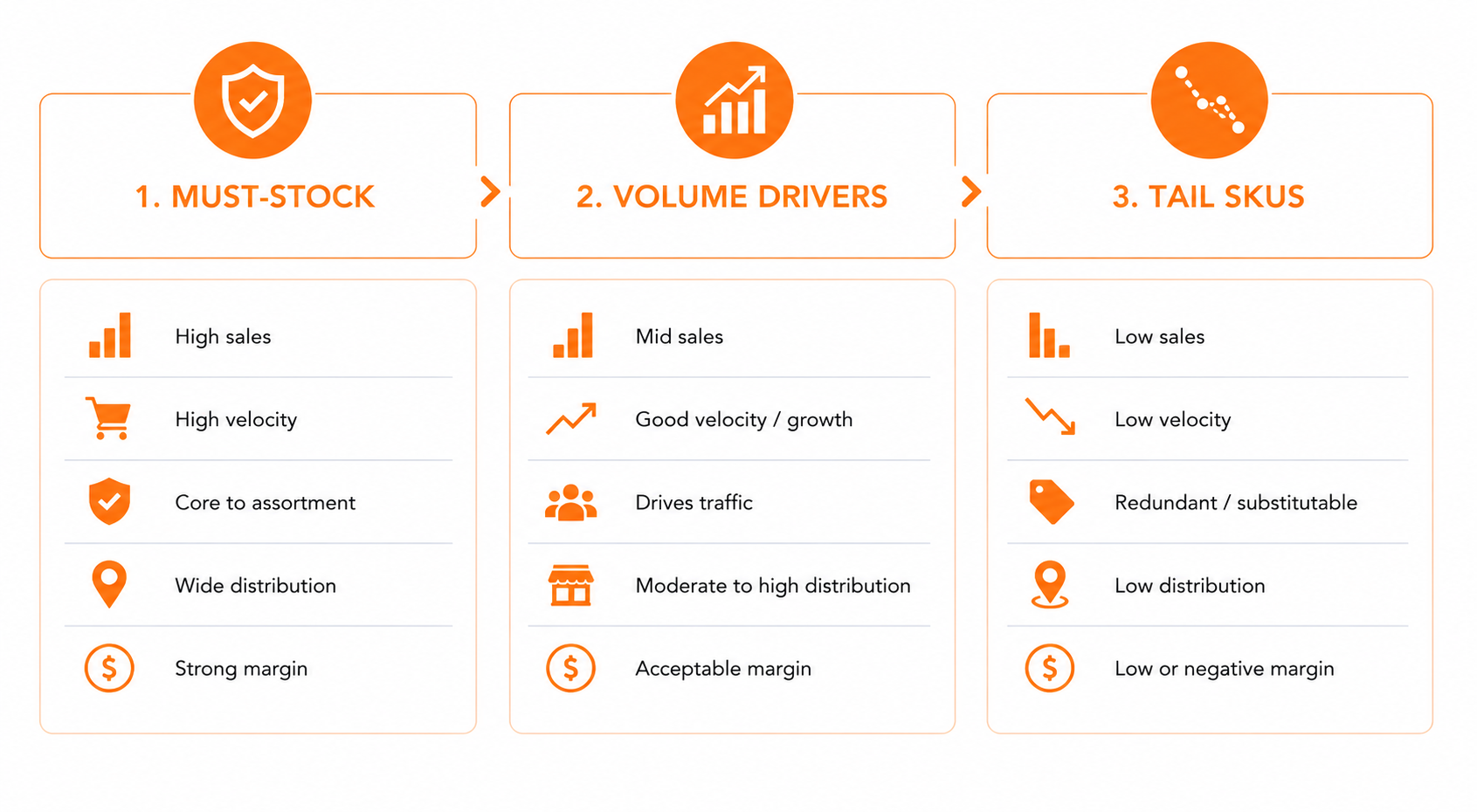
The standard process runs five stages. Stage 1 is the portfolio audit - pulling SKU-level velocity, margin, and substitution data to score the full range. Stage 2 is customer impact scoring - mapping which shoppers use each product and what happens to demand if it's removed. Stage 3 is retailer collaboration - making the case to buyers, agreeing on the delist timeline, and filing the updated planogram. Stage 4 is the phase-out - supply chain wind-down, inventory clearance, and field team briefing. Stage 5 is post-rationalization governance: the category review process cadence that stops SKU count from creeping back up.
The metrics used to decide which SKUs to cut - velocity, true profitability, substitution risk, strategic role - are well-established and rarely where the process breaks down. Whether a brand is rationalizing a single product line or running a full product line rationalization across multiple categories, the scoring criteria are consistent. What the standard five stages don't include is a check that Stage 4 actually happened at store level. The field team was briefed. But were the cut products physically removed from every store? Did surviving must-stock SKUs get the extra facings the updated planogram specified? The process treats these as details that take care of themselves. They don't.
This is also where on-shelf availability becomes the critical thing to watch. Surviving SKUs need to be consistently on shelf across every store in the reset - and maintaining that takes its own operational discipline, separate from the portfolio decision. On-shelf availability failures in the weeks after a reset are one of the most common reasons a rationalization underperforms, and one of the least talked about.
Also Read: On-Shelf Availability: Why Products Go Missing at the Shelf - What inventory records miss and why the gap is widest in the weeks immediately after a planogram reset →
Shelf Space Optimization Only Works If the Reset Actually Happened in Every Store
This is where the execution gap gets concrete. It has three parts, and they compound each other.
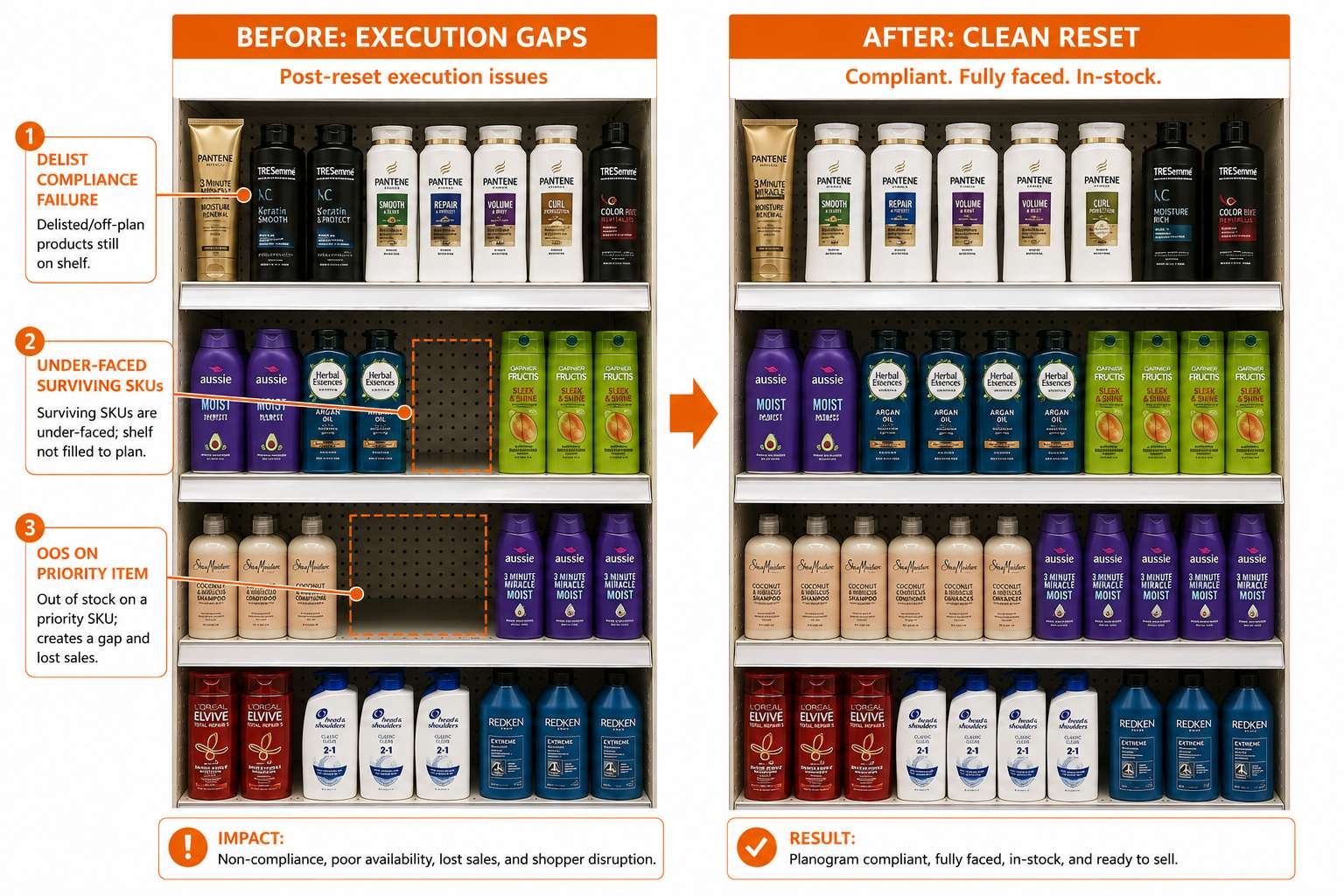
Delist verification. At 500 stores across multiple banners, a product doesn't leave the shelf because a buyer agreed to remove it. It leaves when a store associate physically pulls it, when back-room stock runs out, and when the space gets reassigned. That process doesn't happen at the same time across every store. In the meantime, the cut product sits in its old position - taking up shelf space allocation that was supposed to go to surviving SKUs. Your sell-in data shows zero replenishment for it. Zero replenishment is not the same as the product being gone from every store.
Facing confirmation. The updated planogram says surviving must-stock SKUs get more facings. Whether that actually happened requires a store-level check. A reset filed centrally gets executed locally, and locally varies - some stores finish in week one, some in week three, some not correctly at all. If your shelf reset planning stops at filing the planogram and doesn't include a verification step, you're measuring what was planned, not what's on the shelf.
The OSA feedback loop. Sales data from surviving SKUs in the first 60 to 90 days after a reset is your clearest read on whether the execution worked. If must-stock SKUs are fully faced and in stock, product velocity should improve against the pre-rationalization baseline. If it doesn't, the most likely explanation isn't a bad cut decision - it's that the shelf didn't end up reflecting the plan. Category managers who track this are solving the right problem. The ones who don't spend the next cycle questioning strategy that was never the issue.
Getting this data fast enough to act on it is the challenge. Syndicated sources run three to four weeks behind. ParallelDots' ShelfWatch uses AI image recognition to close that gap - field reps photograph shelves, and the system returns structured data the same day: which cut SKUs are still present, whether surviving products have the right facing counts, and where OSA gaps exist on priority items. Four weeks of undetected execution failure across a 500-store estate is four weeks of shelf productivity the rationalization was supposed to unlock.
Staying on top of the post-reset window isn't a one-time check. It's a planogram compliance function that needs to run for as long as store execution remains variable - which is typically the first 60 to 90 days.
Also Read: Planogram Compliance for CPG Brands - How compliance monitoring works after a category reset, and what to do when stores diverge from the agreed planogram →
What Category Managers Need to Know About SKU Rationalization
A rationalized portfolio sets up better product assortment optimization - cleaner fixtures, stronger facing allocation for the products that move, and a stronger story for the next buyer review. It doesn't deliver those outcomes automatically. The shelf has to follow through. A few questions come up consistently for category managers working through this.
Why do retailers delist products from shelves?
Retailers remove products when a SKU isn't turning fast enough to justify the space it takes, when a brand's rationalization plan calls for cuts, or when a category review leads them to trim assortment depth and make room for private label or faster-moving items. For the retailer, every facing is revenue-generating space - a slow-turning product crowds out one that moves faster. In most cases, a delist is triggered by weak velocity data and a buyer review where the brand can't make a strong enough case for the SKU.
How do you measure SKU performance on the shelf?
Four dimensions: velocity (units sold per store per week), on-shelf availability (how often the product is actually in stock and visible), facing compliance (whether it has the facings the planogram specifies), and share of shelf against competitors in the category. Syndicated scanner data covers velocity with a 3–4 week lag. For OSA rates and facing compliance at a speed that's actually useful, you need field rep audits or computer vision shelf monitoring.
What is the difference between SKU rationalization and product discontinuation?
SKU rationalization is the process - a structured review that can lead to cuts, consolidations, or repositioning decisions across the range. Product discontinuation is one outcome of that process: permanently removing a single SKU, which triggers supply chain wind-down, delist negotiations, and inventory clearance. Rationalization is the methodology. Discontinuation is one thing it produces.
A rationalized national range also needs calibrating by store cluster - what works in one region or format doesn't always work in another. Regional assortment optimization covers that layer.
The Category Managers Who Win the Next Review Are Measuring the Last Reset
SKU rationalization is only as good as the execution that follows it. A solid cut list that leads to a poorly executed shelf reset doesn't improve category performance. It creates weeks of inconsistency - some stores with the new assortment, some with the old - and then generates performance data that mixes execution problems with actual demand signals. You end up reading the wrong thing.
Category managers who close the execution gap go into the next buyer review with something most don't have: evidence. Not projected outcomes, not sell-in data that can't tell replenishment from shelf presence, but actual store-level data showing the assortment is on shelf, must-stock SKUs are correctly faced, and the productivity gains are real. A shelf analytics platform that ties execution data to category decisions is what makes that kind of verification repeatable rather than a one-off effort.
The question worth taking into the next rationalization cycle isn't whether the cut decisions were right. Most of them were. It's whether the shelf reflects those decisions - and whether your data can actually tell you.
.png)
.png)
.png)