Share it with your network.


Revenue growth management is one of the most widely discussed frameworks in CPG commercial strategy. But for most brands, the gap between RGM as a planning discipline and RGM as an operational reality comes down to one problem: the data available to execute it is either too slow, too incomplete, or too aggregated to drive store-level decisions.
RGM, the structured approach CPG companies use to optimize pricing, promotions, product mix, and trade investment for profitable growth, has existed for decades. The frameworks are well understood. The challenge is not knowing what RGM is. The challenge is having the right data to make it work at the shelf, where revenue is actually won or lost.
This blog explains what revenue growth management means for CPG brands, why real-time shelf intelligence has become the missing operational layer for most RGM programmes, and how leading brands are using shelf data to close the gap between commercial strategy and in-store execution. If you are looking for a deeper look at specific RGM strategies and how to implement them, read our guide on RGM strategies for CPG brands
Where RGM Frameworks Break Down Without Shelf Data
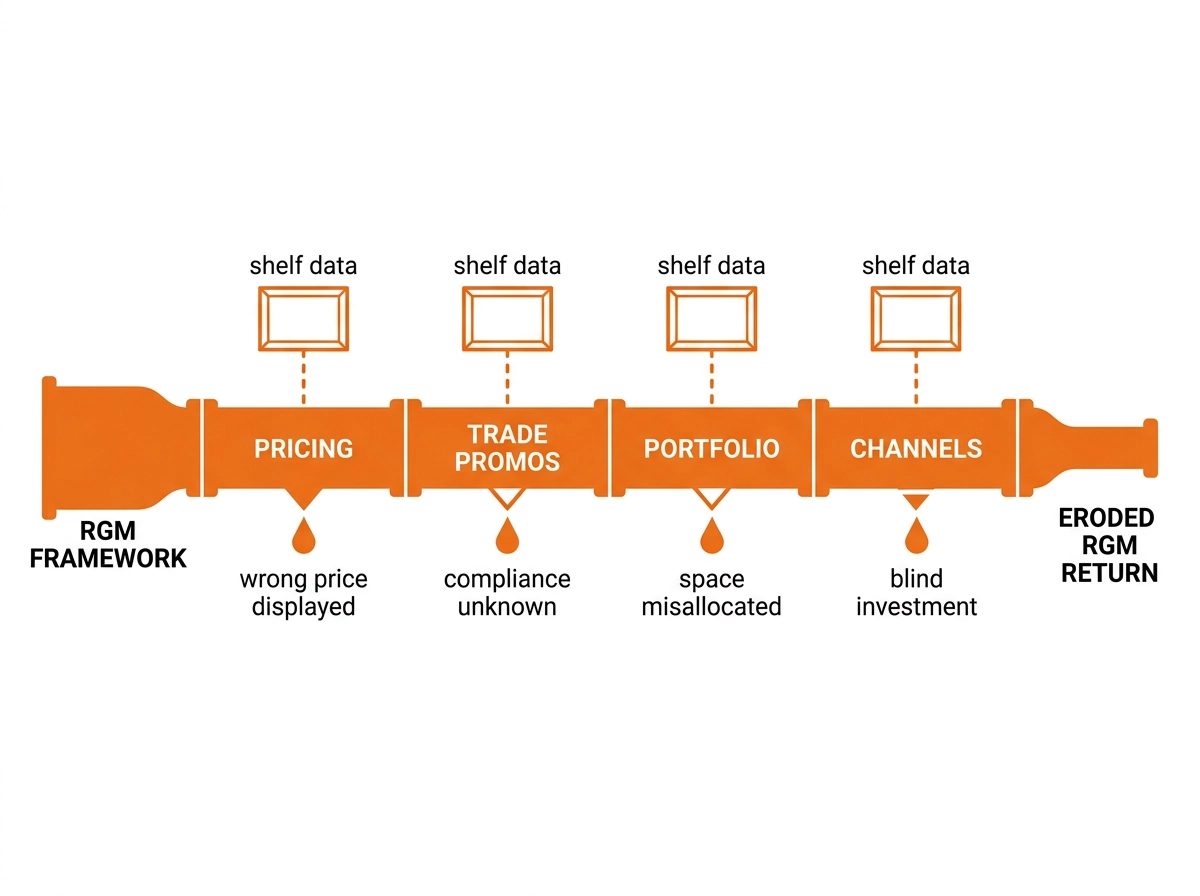
Most RGM frameworks are built around four commercial levers: pricing architecture, trade promotions, product portfolio management, and route to market. Each lever is well-defined in theory. In practice, each one depends on an input that most CPG brands do not have in a reliable form: accurate, real-time data on what is actually happening at the shelf across their entire retail network.
Consider what happens when each lever operates without that data.
Pricing without shelf-level verification
A brand sets a recommended retail price and agrees on promotional pricing with retail partners. Without shelf-level data, there is no mechanism to confirm that the correct price tag is displayed at the correct location on the correct SKU, across every store, every week. Pricing strategy becomes theoretical the moment execution diverges from the plan, and it almost always does at some stores, in some regions, at some point during a campaign window.
The problem is compounded during promotional periods. A brand may agree a 15% off RRP with a key retail account, run the trade investment to fund it, and have no reliable way to confirm that the promoted price is actually displayed at shelf for the full activation window. Stores that show the standard price during a funded promotion are both losing sales and wasting trade spend simultaneously. Without systematic shelf-level pricing verification, these failures are invisible until they surface in sell-through data weeks after the campaign has closed.
Trade promotions without execution visibility
Trade spend is typically 15–25% of gross revenue for large CPG manufacturers. A national promotion scheduled to launch across thousands of stores on a Monday may not appear at a significant portion of those locations until days later, or at all. Without store-level visibility into whether promotional displays are placed correctly, whether price tags reflect the offer, and whether the promoted SKU is even in stock, trade promotion optimization remains a planning exercise. The execution reality is invisible until lagged audit data surfaces, often after the campaign window has closed.
The downstream consequence is that brands routinely fund promotional mechanics that deliver partial execution at best. When compliance rates are unknown, trade ROI calculations are built on assumptions. Post-promotion analysis based on sell-out data cannot isolate whether underperformance was due to weak consumer demand, insufficient promotional mechanics, or store-level execution failures. Without execution data, the same inefficiencies get funded again in the next planning cycle.
Portfolio decisions without shelf performance data
RGM portfolio management, which covers deciding which SKUs to invest in, which to rationalise, and which to protect in negotiations with retailers, requires accurate data on how each SKU performs in physical retail relative to competitors. Without share of shelf measurements at store level, category managers are making space allocation arguments based on sell-in data or aggregated panels, neither of which reflects the moment-of-truth reality on the shelf. The result is misaligned investment and missed category growth.
Channel strategy without granular store data
RGM governs how brands allocate investment across modern trade, general trade, and emerging channels. Each channel has different execution dynamics and compliance rates. Without channel-level and store-level shelf data, brands cannot identify which channels are underperforming on execution, or where field force investment would generate the highest return. Strategic allocation decisions get made on assumptions instead of evidence.
Why Shelf Intelligence Has Become the Operational Layer of RGM
The strategic frameworks of RGM have existed since the 1990s, pioneered by companies like Unilever and Coca-Cola. What has changed fundamentally in recent years is the availability and quality of data that can feed those frameworks in real time.
Historically, CPG brands relied on sell-in data from distributors, periodic manual audit reports from field reps, and aggregated retail panel data from Nielsen or IRI. None of these sources provided real-time visibility into what was actually happening on the shelf. Sell-in data tells you what left the warehouse. It does not tell you whether it is on the shelf, correctly placed, and priced as planned.
AI-powered shelf intelligence platforms change this equation entirely. By capturing shelf images at the store level and processing them through computer vision models, brands gain access to on-shelf availability data, share of shelf measurements, planogram compliance scores, promotional display execution status, and pricing accuracy, all updated in near real time across thousands of store locations.
This is not a reporting upgrade. It is a structural change in what RGM teams can act on. Instead of discovering execution failures weeks after they occur, brand teams can detect and correct them within the same audit cycle, or even the same store visit.
How Shelf Data Feeds Each RGM Decision Point
Pricing verification at scale
ShelfWatch captures price tag data from shelf images and surfaces discrepancies, including whether products are priced above or below the agreed rate, whether pricing is missing entirely, or whether promotional price updates have not been applied across stores. This information feeds directly into the pricing accuracy component of the RGM dashboard. For brands managing planogram compliance across thousands of outlets, this is the only mechanism that provides systematic, scalable verification rather than spot-check sampling.
Closing the trade promotion execution gap
When a national promotion launches, ShelfWatch validates whether endcap placements, point-of-sale materials, and promotional pricing are deployed as planned across the store network. It monitors whether promotional SKUs are in stock during the activation window. Where compliance drops below threshold in specific regions or store clusters, trade marketing teams receive alerts before the campaign window closes, not after. This closes the feedback loop between promotional planning and field execution that traditional trade promotion optimisation frameworks have never been able to address at scale.
Evidence for portfolio and category conversations
Share of shelf measurements from ShelfWatch give category managers a store-by-store view of physical presence versus competitors on the same shelf. Aggregated across geographies and retail channels, this data gives NSMs and category directors the evidence they need to have data-backed conversations with retail partners about space allocation, assortment decisions, and category leadership.
Protecting revenue through on-shelf availability
On-shelf availability is one of the most direct drivers of revenue loss in CPG. Industry data consistently indicates that between 5–8% of products are out of stock on any given day across modern trade. ShelfWatch identifies stockout events at the SKU-store level in near real time, triggering replenishment alerts before the sales window closes. For RGM teams modelling revenue performance, OSA data transforms the conversation from reactive damage assessment to proactive revenue protection.
Pricing Compliance and Promotional ROI: The Shelf Data Advantage
Of all the commercial levers in an RGM programme, pricing and trade promotions represent the highest-stakes execution risk. Pricing errors erode margin directly. Promotional non-compliance wastes trade investment and distorts performance data. Yet for most CPG brands, these two areas remain the least visible at the point where they matter most: the shelf.
ShelfWatch addresses this by treating price tags and promotional mechanics as structured, measurable shelf attributes, not assumptions.
Real-time pricing compliance across the retail network
When a CPG brand agrees a price architecture with a retail partner, it enters a commercial commitment that is only as valuable as its execution. ShelfWatch captures shelf-edge price tags as part of every store image processed, comparing detected prices against the brand's planned price points by SKU, channel, and geography.
The output is a live pricing compliance dashboard that shows, across every store in the network, which SKUs are correctly priced, which are over-priced against the promotional plan, which are missing price tags entirely, and which have not had promotional pricing applied on time. For trade marketing directors and NSMs, this data changes the nature of retailer conversations. Instead of raising pricing discrepancies weeks after a campaign has ended, brands can identify and escalate non-compliant stores during the activation window, when corrective action can still protect revenue.
For enterprise brands operating across multiple retail channels, ShelfWatch also enables cross-channel price monitoring. A brand managing pricing across hypermarkets, convenience, and pharmacy can benchmark whether pricing architecture holds across channel types, or whether specific retail formats are systematically deviating from plan.
Trade promotion compliance: from spend to execution to outcome
The traditional trade promotion lifecycle has a significant blind spot between the point of investment approval and the point of sell-out measurement. Brands fund promotional mechanics, field reps report qualitative compliance, and sell-out data arrives too late to course-correct. The result is that trade ROI calculations are routinely built on execution assumptions rather than evidence.
ShelfWatch closes this blind spot by converting promotional compliance into a quantifiable shelf metric. For any active promotion, the platform tracks whether secondary placements (endcaps, aisle fins, floor displays) are in position, whether promotional price tags are displayed on the primary shelf, whether POS materials are correctly placed and visible, and whether the promoted SKU is available throughout the campaign window. Each of these data points is captured at the store level, time-stamped, and aggregated into a promotional compliance score.
For ParallelDots' clients, this data creates a direct line of sight between trade investment and shelf reality. A brand running a high-value promotion across 5,000 stores that achieves 72% promotional compliance can immediately identify the 1,400 stores where investment is not translating to execution, prioritise field force intervention in the highest-revenue stores, and build an evidence-based case for retailer corrective action. Post-campaign, the same compliance data feeds into ROI modelling, allowing trade marketing teams to separate execution variance from genuine demand signals when evaluating promotional performance.
How ShelfWatch fits into the pricing and promo workflow
ShelfWatch integrates with existing trade promotion management (TPM) tools and SFA systems, meaning promotional parameters, including planned pricing, display mechanics, and activation windows, can be ingested directly into the platform. Compliance is then measured against the agreed promotional brief, not a generic standard. Alerts surface in the field force app in real time, so store-level corrective actions happen during the campaign, not in the post-mortem.
For RGM leaders, the practical implication is straightforward: every promotional investment now has an execution audit built into the workflow. The gap between what was planned and what was deployed becomes measurable, manageable, and, over time, systematically smaller.
Perfect Store Execution as the Bridge Between RGM Strategy and Shelf Reality
In RGM terminology, the Perfect Store framework defines the ideal in-store conditions required for a brand to maximise its revenue at point of sale: the right products, in the right positions, with the right pricing and promotions, visible to the right shoppers, at the right time. Perfect store execution is, in essence, where RGM strategy becomes store-level action.
The gap between a brand's Perfect Store definition and what is actually observed on shelves is where RGM programmes either deliver results or fall short. Most brands can describe their Perfect Store standard in detail. Far fewer can measure the distance between that standard and reality across every store in their network, every week.
ShelfWatch is designed specifically to measure and close that gap. By comparing what is captured in shelf images against the Perfect Store definition, covering planogram, pricing, promotion, and availability, ShelfWatch generates a compliance score for each store visit that field teams can use to prioritize corrective actions. Over time, this data reveals which store clusters, regions, or retail partners consistently underperform on execution quality, enabling more targeted investment in field force capacity and retailer engagement.
What RGM Leaders Should Expect From a Shelf Intelligence Platform
For NSMs, trade marketing directors, and category managers who are either building or scaling an RGM programme, integrating shelf intelligence data is no longer a technology project. It is a commercial requirement. Brands that continue to rely on lagged, manually-collected audit data to inform their RGM decisions are making strategic investment calls based on a fundamentally incomplete picture of retail reality.
A shelf intelligence platform that genuinely supports RGM decision-making should deliver:
- Daily or weekly OSA scores by store cluster and channel
- Promotional compliance rates across all active campaigns, measured at the store level against the agreed promotional brief
- Pricing accuracy verification across channels and geographies, with real-time alerts for deviations
- Share of shelf benchmarks versus defined competitive sets
- Planogram deviation reports prioritised by revenue impact
All of this should surface through configurable dashboards that align with how commercial teams actually work, not how data teams structure reports. These inputs transform RGM from a quarterly commercial planning exercise into a continuous, closed-loop system where strategy and execution are connected by the same real-time data stream.
How ShelfWatch Supports RGM at Enterprise Scale
ParallelDots' ShelfWatch is deployed across 50+ countries, processing millions of shelf images monthly for some of the world's largest CPG manufacturers, including clients across beverage, personal care, packaged food, tobacco, and OTC pharmaceutical categories.
ShelfWatch integrates with field force apps, SFA systems, CRM platforms, and trade promotion tools, embedding shelf data directly into the commercial workflows where RGM decisions are made. This means the data does not sit in a separate analytics portal. It surfaces in the tools that NSMs, trade marketing directors, and field teams already use to manage their programmes.
For CPG brands looking to strengthen their revenue growth management programme with accurate, real-time shelf data, ShelfWatch provides the operational visibility that turns RGM strategy into measurable store-level outcomes. Whether the priority is improving OSA scores during high-value promotions, benchmarking share of shelf against competitors in key accounts, verifying pricing compliance during active promotional windows, or confirming perfect store compliance across a distributed field force, ShelfWatch delivers the evidence that commercial leaders need to make faster, more confident decisions.
To see how ShelfWatch supports RGM programmes in practice, request a demo.
Further Reading
→ Strategies for Effective CPG Revenue Growth Management
→ Trade Promotion Optimization for CPG Success
→ Share of Shelf: Why It Matters and How to Measure It
→ Planogram Compliance in Retail
→ On-Shelf Availability and Its Business Impact
→ The Complete Guide to Retail Execution and Monitoring
.png)
.png)
.png)