Share it with your network.


What Is Trade Promotion Management? A CPG Guide for 2026
Trade promotion management (TPM) is the process consumer goods companies use to plan, budget, execute, reconcile, and evaluate the money they spend with retailers to drive sales. It governs every promotional dollar a brand invests in discounts, displays, and retailer incentives, and it exists to make sure that spend, often the second-largest line on the P&L, actually returns profitable growth.
That definition is well understood. Almost every brand can describe the TPM cycle, and most run some version of it through a dedicated tool or a wall of spreadsheets. The harder question is not what trade promotion management is. It is whether the system you use to manage trade spend can see what that spend actually buys you on the shelf.
Because here is the structural limit built into most TPM programmes: they record what was planned and what was paid. They do not record what happened in the store. A promotion can be funded, approved, and settled in full while the display never goes up, the price tag never changes, or the SKU sits out of stock for half the campaign. TPM captures the commitment. It rarely captures the execution.
This guide explains what trade promotion management includes, how it differs from trade promotion optimisation, why CPG brands invest so heavily in it, and where the discipline breaks down without execution data. If you manage trade spend and want to understand where the money quietly leaks, the shelf is where this story ends.
Key Takeaways
- TPM is how CPG brands plan, budget, execute, reconcile, and evaluate trade spend with retailers.
- It runs in five stages: budgeting, planning, execution, reconciliation, and evaluation.
- TPM is backward-looking; TPO is forward-looking. They work together.
- CPG brands spend 11–27% of revenue on trade promotions, often their second-largest cost.
- TPM's blind spot is execution: it tracks what was planned and paid, not what reached the shelf.
- Shelf intelligence closes that gap with real-time, store-level execution data.
What Does Trade Promotion Management Include?
Trade promotion management covers the full lifecycle of a trade investment, from the moment a budget is set to the moment a promotion's results are analysed and fed into the next plan. It is best understood as a closed loop of five stages, each of which depends on the accuracy of the one before it.
1. Budgeting and allocation. The cycle starts with setting the trade budget and dividing it across accounts, channels, and time periods. This is where a brand decides how much of its revenue to commit to trade spend and how to distribute that commitment across its retail partners. Allocation decisions made here shape everything downstream, which is why brands that get budgeting wrong rarely recover the difference later in the cycle.
2. Promotion planning and forecasting. Next, brands build a promotional calendar for each retail customer, starting from a sales baseline and layering on the expected uplift from each planned event. Accurate forecasting depends on clean historical data and a reliable read on what previous promotions actually delivered, which is precisely where execution blind spots begin to distort the numbers.
3. Execution. This is where the plan meets the store. The promotion is communicated to retailers, display materials and point-of-sale assets are supplied, agreed pricing is meant to go live, and the event runs across the network. Most TPM frameworks describe this stage in a single line, treating it as logistics. In reality, this is the stage where trade investment is most often lost, and the stage TPM systems are least equipped to verify.
4. Reconciliation and settlement. After the promotion runs, spend has to be matched to activity. Deductions are validated, claims are settled, and the financial record is balanced. When execution data is missing, reconciliation is forced to assume the promotion ran as planned, which means a brand can pay in full for an event that only partially happened.
5. Evaluation and post-event analysis. Finally, the brand measures what the promotion delivered, sales lift, incremental volume, return on the trade dollar, and turns those findings into recommendations for the next cycle. The quality of this analysis is capped by the quality of the execution data behind it. If you cannot separate weak demand from weak execution, you risk re-funding the same failures in the next plan.
The Trade-Spend Vehicles You Are Actually Managing
Trade spend is the money a manufacturer pays retailers to stock, discount, and promote its products. It moves through several specific vehicles, and understanding them matters, because each one carries a different level of execution risk:
- Off-invoice: A discount deducted directly from the invoice at the time of purchase. Simple to apply, but offers little visibility into whether the saving reaches the shelf.
- Bill-back: The retailer buys at full price and later bills the manufacturer for the agreed discount, typically tied to performance. More accountable, but heavier to reconcile.
- Scan-down: A discount applied at the point of sale and paid on actual units sold through to shoppers. Because payment follows real sell-through, scan-downs reward correct in-store execution, and penalise its absence.
- Manufacturer charge-back (MCB): A promotional deal where a retailer buys from a distributor at a reduced rate and the manufacturer absorbs the difference on a future payment.
- Slotting fees and co-op advertising: Payments to secure shelf placement or to share the cost of promoting specific products in-store and in ad campaigns.
- Everyday low price (EDLP): A standing low-price strategy rather than a temporary event, funded through ongoing trade terms.
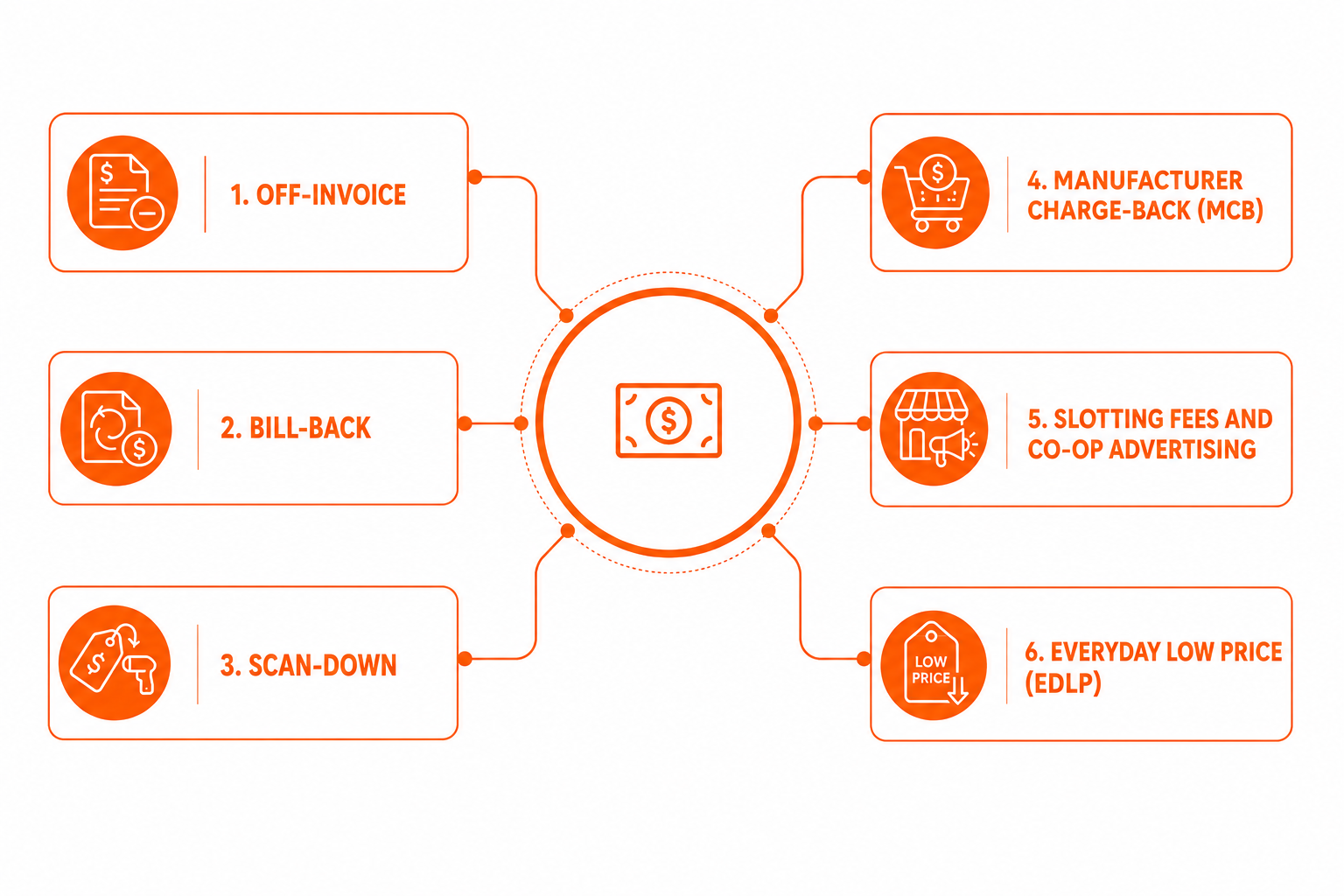
The common thread is that the more a payment depends on what actually happens at the shelf, as with scan-downs and bill-backs, the more a brand needs reliable execution data to know whether it is funding results or funding assumptions. That is the thread this guide follows from here.
TPM vs TPO: What Is the Difference?
Trade promotion management and trade promotion optimisation (TPO) are often used interchangeably, but they answer two different questions.
TPM is backward-looking. It records what a brand committed to, what it spent, and what it settled. Its core question is operational: did we plan, fund, and reconcile this promotion correctly? TPO is forward-looking. It uses historical lift data and predictive analytics to decide where the next dollar should go. Its core question is strategic: where should we invest next quarter to hit our revenue and margin targets?
Trade Promotion Management (TPM)
Trade Promotion Optimisation (TPO)
Orientation
Backward-looking
Forward-looking
Core question
Did we plan, fund, and settle correctly?
Where should we invest next?
Primary input
Plans, budgets, deductions, settlements
Historical lift, baselines, predictive models
Output
An accurate record of trade spend
A smarter allocation of trade spend
The two are not rivals. TPO is the layer that sits on top of a working TPM foundation. You cannot optimise what you cannot reliably manage, and you cannot optimise accurately if the historical data feeding your models reflects what you planned rather than what actually ran in-store. This is the quiet dependency behind both disciplines: optimisation is only as trustworthy as the execution data underneath it.
Why Does Trade Promotion Management Matter for CPG?
Trade promotion is one of the largest investments a consumer goods company makes. CPG brands commonly spend between 11% and 27% of revenue on trade promotions, which makes it frequently the second-largest line on the P&L after cost of goods sold. At that scale, even small improvements in how trade spend is managed translate into material profit.
The problem is that a large share of that investment underperforms. Industry research has long shown that up to 80% of promotional spend fails to drive incremental category growth, and that many consumer goods executives are dissatisfied with the returns they see on trade spend. When the second-biggest cost on the P&L delivers uncertain results, managing it well stops being an administrative task and becomes a commercial priority.
Done properly, trade promotion management delivers four tangible benefits:
- Higher sales, by encouraging retailers to stock more and feature products more prominently.
- Stronger margins, by reducing wasted, duplicated, or unauthorised spend and tightening the link between investment and return.
- Greater brand visibility, by securing better shelf presence and in-store support.
- Better retailer relationships, by giving partners a clear, accountable framework for joint promotional planning.
Each of these benefits, though, assumes the promotion is executed as planned. That assumption is exactly where most TPM programmes are most exposed.
The Biggest Challenges in Trade Promotion Management
Most TPM difficulties trace back to a small number of recurring problems:
- Data silos and manual spreadsheets. When promotional data is scattered across teams and tools, there is no single source of truth, and measuring ROI becomes guesswork.
- Forecasting accuracy. Baselines and uplift are hard to model reliably when the historical record is incomplete or distorted by unverified execution.
- Deduction and reconciliation backlogs. Unvalidated claims and ageing deductions tie up finance teams and obscure how much was really spent.
- Multi-stakeholder coordination. Sales, finance, marketing, and retail partners all touch the same promotion, and information gets lost between them.
These are well-documented, and good TPM software addresses most of them. But they share a deeper, less-discussed root. Every one of these challenges assumes that once a promotion is approved and funded, it runs the way it was designed. The data silos, the forecasting errors, the reconciliation backlogs, all of them get worse when the system has no reliable way to confirm what actually happened in the store. Which brings us to the gap that sits underneath all of them.
Why Execution Data Matters for TPM
Here is the structural limit of trade promotion management: a TPM system records what was planned and what was paid. It has no eyes in the store. The plan and the execution are treated as the same thing, when in practice they routinely diverge.
The size of that divergence is well documented. In a large-scale store audit, CPG brands estimated their promotional display compliance at around 70%, while the actual rate in stores was closer to 40%, and roughly 60% of promotional displays were set up in the wrong place, with the wrong product, or not at all. The Promotion Optimisation Institute similarly reports that the majority of CPG companies struggle to execute promotions as planned, and NielsenIQ has found that 55% of trade promotion dollars fail to lift market share or category growth. The trade dollar is spent in full; the execution arrives in part.
For a TPM programme, that gap quietly corrupts every stage downstream of execution. Reconciliation settles spend against an event that may have only partly happened. Post-event analysis cannot separate weak consumer demand from weak execution, so genuine demand signals get muddled with store-level failures. The next forecast inherits distorted history, and the same underperforming mechanics get funded again. None of this is visible inside the TPM system, because the system was never designed to see the shelf.
Closing the gap requires a feedback loop that TPM alone does not have: a reliable, ongoing read of what is actually happening in stores while the promotion is live. This is the role of AI-powered shelf intelligence. By capturing shelf images at store level and processing them through computer vision, a platform like ShelfWatch turns in-store execution into structured, measurable data, confirming whether the display went up in the right position, whether the promotional price tag is showing, whether point-of-sale materials are placed correctly, whether the shelf follows the agreed planogram, and whether the promoted SKU stays in stock, true on-shelf availability, through the activation window.
Crucially, this data arrives in time to act on. Instead of discovering a 60% compliance rate weeks after a campaign closes, trade marketing teams can see which stores and regions are falling short while the promotion is still running, and direct field effort to the locations where the investment is most at risk. The result is that reconciliation reflects reality, ROI analysis separates execution from demand, and the next planning cycle is built on what happened rather than what was assumed. Trade promotion management becomes a genuine closed loop, not an open-ended commitment.
How Do You Measure Trade Promotion ROI?
Most brands evaluate promotional performance through a consistent set of metrics:
- Sales lift: the increase in units or dollars during the promotion versus the baseline.
- Incremental sales: the additional volume directly attributable to the event, ideally expressed in manufacturer revenue.
- Event spend: total trade spend on an event as a percentage of the revenue it generated.
- Cost per incremental dollar (CID): how much trade investment it took to generate each incremental dollar of sales.
- Return on investment (ROI): the profit-based return on the trade dollars committed.
Each of these is only as trustworthy as the execution data behind it. A campaign that achieves real-world compliance of 60% will report a muted lift, but the number says nothing about why, and a brand that cannot distinguish poor execution from poor demand will draw the wrong conclusion from the same figure. Execution data is what lets these metrics measure the promotion you actually ran, rather than the one you planned.
Do You Need Trade Promotion Management Software?
If trade promotion is a small, simple part of your business, spreadsheets may still hold. The signs that you have outgrown them are familiar: a high volume of complex promotions across multiple accounts and channels, data scattered across disconnected systems, forecasting that is more hope than model, a growing deduction backlog, and retailer collaboration that depends on emailed files.
Good TPM software brings planning, budgeting, forecasting, deduction management, and post-event analytics into one place, and scales into TPO and revenue growth management as a brand matures. The one capability to weigh alongside it is execution visibility. A TPM platform that ingests real shelf data, rather than assuming the plan was followed, gives every other feature something accurate to work with, which is why leading shelf intelligence platforms are built to integrate directly with existing TPM and field-force systems.
Turning Trade Spend Into Shelf Reality
Trade promotion management gives CPG brands a disciplined way to plan, fund, and account for one of the largest investments they make. But the discipline is only complete when the loop closes, when a brand can see not just what it intended to spend, but what that spend actually delivered on the shelf.
That is the difference between managing trade spend and managing trade outcomes. TPM tells you what you committed to. Shelf intelligence tells you what you got for it. Brands that connect the two stop funding assumptions and start funding results.
To see how ShelfWatch brings real-time execution data into your trade promotion workflow, request a demo.
Further Reading
- Revenue Growth Management (RGM) for CPG: What It Is and How Shelf Data Powers It
- Trade Promotion Optimization for CPG Success
- Promotion and Pricing Compliance
- On-Shelf Availability and Its Business Impact
- The Complete Guide to Retail Execution and Monitoring
5. FAQs
What is trade promotion management?
Trade promotion management (TPM) is the process CPG companies use to plan, budget, execute, reconcile, and evaluate the trade spend they invest with retailers, such as discounts, displays, and promotional pricing, to drive sales and protect profitability.
What does trade promotion management include?
TPM includes five stages: budgeting and allocation, promotion planning and forecasting, execution, reconciliation and settlement, and post-event evaluation. It also covers the trade-spend mechanics behind them, including off-invoice, bill-backs, scan-downs, and slotting fees.
What is trade spend?
Trade spend is the money a CPG manufacturer pays retailers to stock, discount, and promote its products. It includes vehicles such as off-invoice discounts, bill-backs, scan-downs, slotting fees, and co-op advertising, and it is the budget that trade promotion management plans, tracks, and reconciles.
What is the difference between TPM and TPO?
TPM is backward-looking and records what was planned, spent, and settled. Trade promotion optimisation (TPO) is forward-looking and uses historical data and predictive analytics to decide where to invest next. TPO builds on a working TPM foundation.
How much do CPG companies spend on trade promotions?
CPG companies typically spend between 11% and 27% of revenue on trade promotions, frequently making it the second-largest expense on the P&L after cost of goods sold.
Why do trade promotions fail in-store?
Promotions fail when the plan does not match the execution. Displays go up late or not at all, promotional price tags are missing, point-of-sale materials are misplaced, or the promoted product is out of stock. Audits often find real compliance well below what brands assume, which is why execution data is essential to managing trade spend.
.png)
.png)
.png)