Share it with your network.


Secondary display compliance is the measurement of whether out-of-aisle promotional placements – endcaps, POSM, dump bins, and promotional islands – are executed correctly, on time, and for the full duration of a campaign window. For most CPG brands, that measurement does not exist in a reliable form.
Brands invest heavily in secondary displays: negotiating placement fees, designing point-of-sale materials, briefing field teams, and building promotional calendars with retail partners. What they rarely have is verified, store-level evidence that execution matched the brief - across every store, from the first day of the campaign to the last. Self-reported photos and periodic manual audits fill the gap. They consistently overstate what is actually happening on the floor.
The primary shelf has received the industry's attention. Planogram compliance, share of shelf, and on-shelf availability are now established disciplines for most large CPG manufacturers. Secondary displays have not received the same rigour. They are treated as a deployment problem rather than a measurement challenge - and that gap costs trade marketing compliance teams both spend efficiency and commercial credibility.
What Secondary Display Compliance Actually Measures
Secondary display compliance tracks whether promotional placements are present in the right stores, set up correctly against the campaign brief, and live for the full promotional window. Understanding what falls within the category is the starting point for measuring it correctly.
Endcaps
Endcap compliance is harder to measure than primary shelf compliance because endcaps are contested space. Retailers manage allocation across multiple brand partners simultaneously, and the promotional calendar at store level rarely executes as cleanly as the joint business plan suggests. Endcaps get delayed, reassigned, or set up with the wrong SKU mix. Without independent verification, those failures are invisible until they surface in sell-out data - well after the campaign window has closed.
POSM
POSM compliance refers to whether point-of-sale materials - shelf talkers, wobblers, standees, header boards, floor decals - are present, correctly placed, and reflecting the current campaign brief. POSM is almost entirely brand-funded and retailer-executed, which creates a natural accountability gap.
A display can be physically present and completely stripped of its POSM, meaning the promotional message, price communication, and brand identity at the moment of purchase are all absent. The structure passes an audit. The compliance picture is significantly worse than it appears.
POSM accuracy also has to be measured against the specific brief – not a static planogram reference – because the materials change with every activation.
Why Planogram Compliance Logic Does Not Apply
Primary shelf planogram compliance measures against a permanent standard. A store visit at any point in the week captures the same reference. Secondary displays are campaign-specific and time-bound.
A store can pass a compliance check run on Day 5 of a 7-day promotional window even if the display was missing for the first four days. The field report shows compliant. The trade investment return tells a different story.
Also Read: Benefits of Image Recognition in Trade Promotion
Why "Present" Is the Wrong Question
Most brands measure secondary display compliance as a binary: the display is either up or it is not. That framing misses what actually determines whether the trade investment performed.
Secondary displays have a defined compliance window - a promotional period during which they must be live, correctly executed, and stocked with the right SKUs. Presence at one point in time is not the same as compliance across the full window.
Consider a brand running a 7-day endcap programme across 2,000 stores. If 20% of those stores set up the display on Day 4, that is 400 locations where the brand funded four days of lost exposure. The field report at the end of the week shows the display was present. The trade ROI does not reflect what was actually delivered.
Promotional sales uplift is front-loaded. Late setups and early teardowns – common in high-traffic stores where the retailer's operations team is under space pressure – disproportionately hurt returns. Neither failure shows up in a compliance check that only asks whether the display existed.
Genuine measurement requires three questions, not one: Was it up on time? Was it set up correctly? Did it stay live for the full window?
Stop letting POSM and endcap compliance gaps go unverified until the post-mortem.
Most trade marketing teams find out their secondary display compliance failed in a campaign review – after the window has closed and the sales are gone. ShelfWatch gives brands real-time, image-verified compliance data so corrective action happens during the activation, not after it.
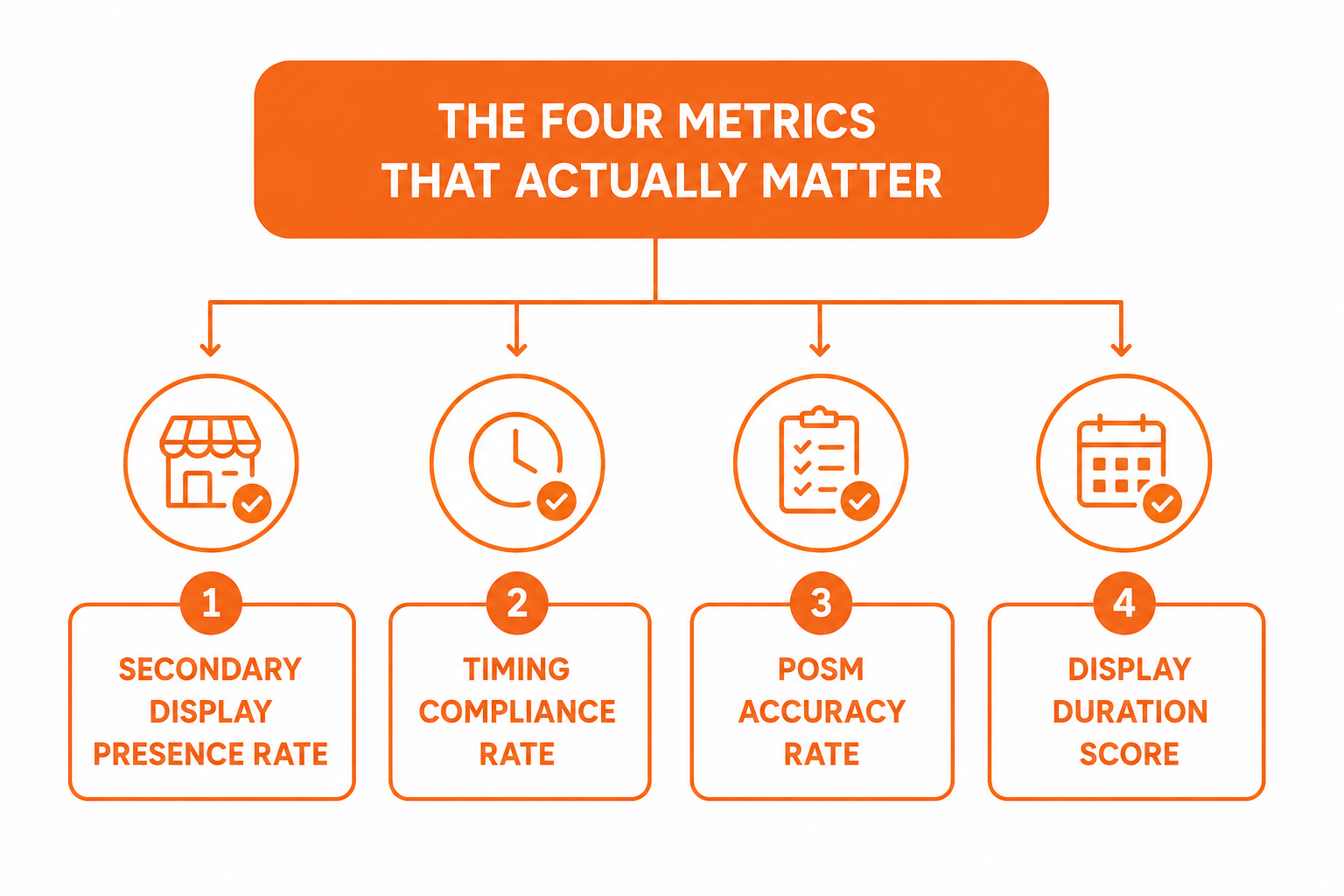
The Four Metrics That Actually Matter
Measuring secondary display compliance at scale requires KPIs that map to timing, accuracy, and duration – not borrowed planogram metrics.
1. Secondary Display Presence Rate
The percentage of stores where the display was confirmed present during the active promotional window: (stores with confirmed display ÷ total stores in programme) × 100. This is the baseline. Without it, everything else is an assumption.
2. Timing Compliance Rate
The percentage of stores where the display was live from the start of the campaign, or within the agreed setup window. This is the metric most brands are not tracking – and the one most directly connected to whether the promotional display compliance delivered its intended return.
3. POSM Accuracy Rate
Whether all planned point-of-sale materials are present, correctly placed, and matching the current campaign brief. Because POSM changes every activation, this metric has to be evaluated against the specific brief – not a static standard.
4. Display Duration Score
Whether the display remained live for the full promotional period. Aggregated across retailers and store formats, duration data surfaces which partners consistently pull displays early – and where field force intervention is needed before campaign close.
Also Read: Benefits of Image Recognition in Trade Promotion
Why Manual Audits Cannot Close This Gap
Manual field audits have a structural limitation: they capture one moment in time, on the day the rep visits. That is not the same as compliance across the promotional window.
When brands move from self-reported to image-verified compliance, the gap between perceived and actual execution is consistently significant – and almost always in the wrong direction. CPG brands often assume their displays meet the agreed standards, but discrepancies between what was planned and what was deployed are common, and they rarely surface through self-reporting alone.
AI-powered image recognition addresses this by turning every store visit photo into a structured compliance audit. When a field rep, merchandiser, or third-party auditor captures a store image and uploads it through an app, ShelfWatch processes it automatically – confirming display presence, SKU accuracy, POSM placement, and promotional pricing against the agreed brief. No manual review. No subjective interpretation.
Compliance is measured against the promotional brief, not a generic standard. Timestamped photo data maps against the active promotional window so trade marketing compliance teams can track execution in real time and act before the campaign closes. Exception alerts flag non-compliant stores as they are identified – so corrective action happens during the activation, not in the post-mortem.
What Verified Compliance Data Changes for Trade Marketing
Compliance data has limited value as a reporting metric. Its real value is in what it changes downstream.
Verified compliance rates give trade marketing teams three things self-reported data cannot.
First, a credible basis for retailer conversations. Store-level compliance evidence turns non-compliance from a disputed claim into a documented commercial issue.
Second, a way to isolate execution failure from genuine demand weakness. Post-promotion analysis routinely misattributes underperformance to weak consumer response when the actual cause was poor execution. Promotional display compliance data separates those two signals – protecting against the mistake of defunding effective mechanics because execution failures looked like demand problems.
Third, a feedback loop for programme design. Compliance patterns across retailers, regions, and store formats reveal where execution consistently breaks down. That intelligence should directly inform how the next programme is structured, which accounts receive higher-touch support, and where trade investment generates the highest verified return.
Secondary display compliance is not a field execution problem. It is a measurement problem. The brands that treat it as such – tracking timing, accuracy, and duration through image recognition rather than self-reported data – are the ones that can connect trade investment to shelf reality and make that connection count in commercial decisions.
ShelfWatch helps CPG brands verify endcap and POSM compliance at scale, automatically, from store photos, in real time. Request a demo to see how it works across your retail network.
Further Reading
→ Monitoring Retail Display Compliance Using Image Recognition
→ Benefits of Image Recognition in Trade Promotion
→ AI Merchandising Compliance Increasing Retail Standards
→ 5 Effective CPG Display Strategies for Brands

.png)
.png)