Share it with your network.


Phantom inventory in CPG retail is stock that a retailer's inventory or point-of-sale system records as available when the product is actually missing from the shelf. The records say in stock, but the shopper finds an empty facing. For CPG brands, this hidden gap between data and reality quietly drains sales, distorts demand forecasts, and delays replenishment.
A shopper walks down the aisle, reaches for your product, and finds an empty space where it should be. They do not wait. They pick up a competitor's pack or leave without buying. Meanwhile, every system between the store and your headquarters insists the item is in stock. The point-of-sale data shows units on hand. The replenishment system sees no reason to reorder. The availability dashboard is green. Nothing is flagged, because as far as the data is concerned, nothing is wrong.
This is phantom inventory, and for CPG brands it is one of the most expensive problems in retail precisely because it hides in plain sight. A normal out-of-stock is at least visible once someone checks the shelf. Phantom inventory is an out-of-stock that the system has decided does not exist. The longer it goes unseen, the more sales it quietly removes from your numbers. This article explains what phantom inventory is, why it hits CPG brands harder than the retailers who carry their products, what causes it, and how shelf image recognition finally closes the gap between what the records claim and what is really on the shelf.
What Is Phantom Inventory in CPG Retail?
Phantom inventory is the difference between the stock a system believes is available and the stock that physically exists where it can be sold. The inventory record shows a positive quantity. The shelf, the backroom, or the location that record points to does not actually hold a saleable unit. The two should match. When they drift apart, the gap is phantom inventory.
In a CPG context this matters most at the shelf, because the shelf is where the sale is won or lost. A retailer's books can be perfectly balanced at the store level while individual facings sit empty. A pack might be in the backroom but not on the shelf, marked sold in the system but never scanned out, misplaced in the wrong aisle, damaged and removed without an adjustment, or simply lost to theft. In each case the record says the product is there for the shopper, and in each case the shopper cannot buy it. The result looks identical from the customer's point of view: the brand was unavailable at the moment of decision.
This is what separates phantom inventory from a routine stockout. A routine stockout is an honest zero. Everyone can see the shelf is empty, and replenishment is triggered. Phantom inventory is a dishonest positive. The number on the screen actively prevents the correction that would put product back in front of the shopper. That is why it persists, and why it costs so much before anyone notices.
Why Phantom Inventory Hits CPG Brands Harder Than Retailers
It is tempting to file phantom inventory as a retailer's housekeeping issue. For CPG brands, that view is a mistake. The retailer absorbs a single lost transaction. The brand absorbs the lost sale, the distorted demand signal that follows it, and the longer-term erosion of shopper loyalty, all at once.
Start with the lost sale. When a shopper cannot find your product, a meaningful share of them substitute a competitor rather than wait or search. That substitution does not just cost one purchase. It teaches the shopper that the competitor is the reliable choice in that category, which compounds over repeat trips. Then consider the data damage. Phantom inventory feeds bad numbers into forecasting. If the system thinks units are selling through at a normal rate while the shelf is actually empty, demand planning underestimates true demand, replenishment stays too low, and the brand starves the exact stores where it is selling out. The error reinforces itself.
There is also a trade and accountability cost that is unique to manufacturers. CPG brands invest heavily in trade promotions, planogram agreements, and perfect store programs to earn presence on the shelf. Phantom inventory silently breaks the link between that investment and its return. The brand pays for the placement, the shelf goes empty without anyone registering it, and the promotion underperforms for reasons the post-campaign analysis never captures. The money was spent. The execution failed invisibly.
What Causes Phantom Inventory on the Shelf
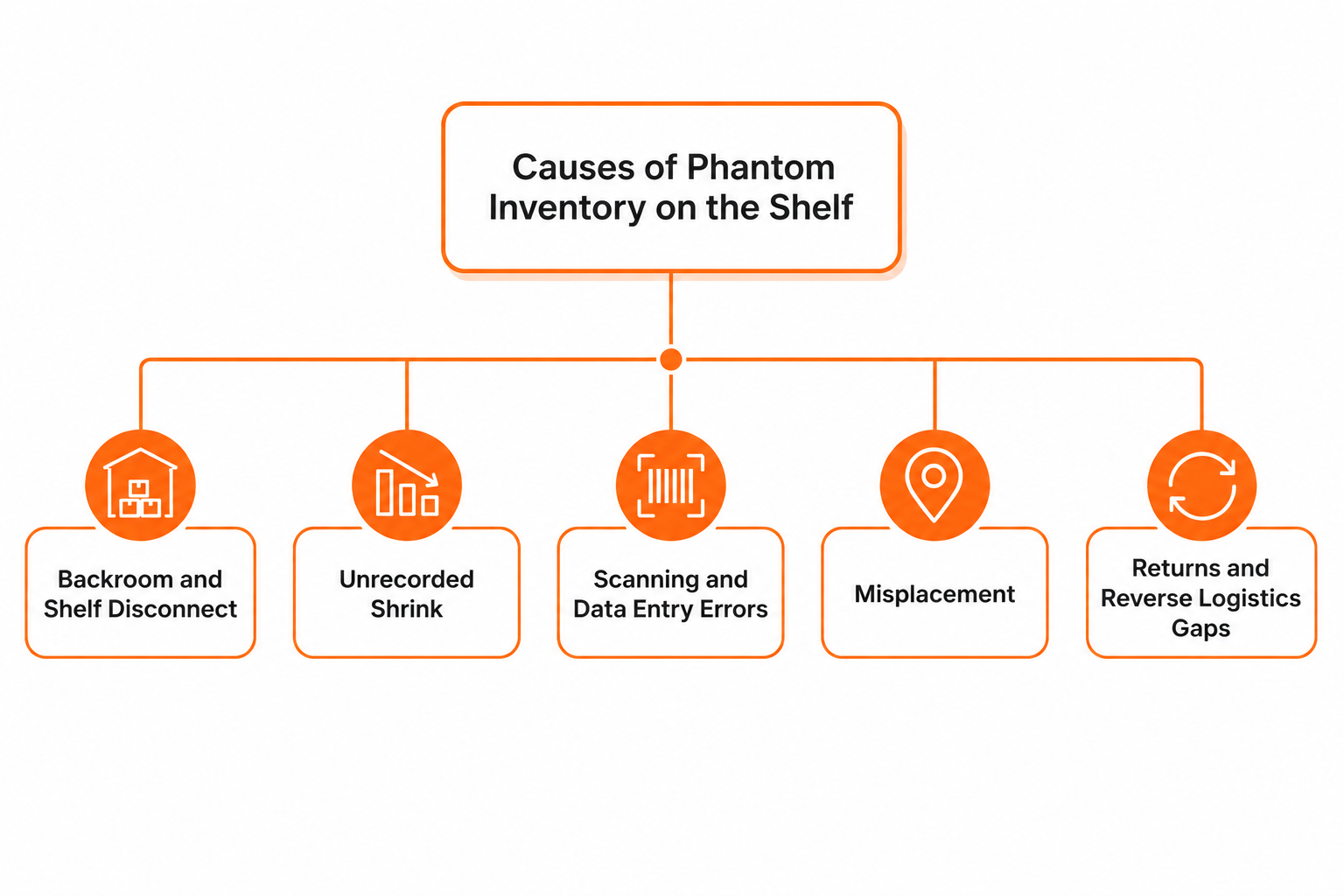
Phantom inventory is rarely the result of one failure. It builds up from several small, ordinary breakdowns in how stock is tracked and moved. The most common sources for CPG products in retail are these:
- Backroom and shelf disconnect. Stock arrives and is received into the system, so the record shows it as available, but it never makes it from the backroom to the shelf. The data counts it as sellable while it sits out of reach of the shopper.
- Unrecorded shrink. Theft, damage, spoilage, and breakage remove physical units without a matching inventory adjustment. The system keeps counting product that no longer exists.
- Scanning and data entry errors. Mis-scans at receiving, at the register, or during returns create quantities that do not reflect reality. Manual processes and complex procedures make these errors routine rather than rare.
- Misplacement. A pack shelved in the wrong location or pushed to the back of a facing is physically present but functionally invisible to the shopper and unreliable for the system.
- Returns and reverse logistics gaps. Returned or recalled units that are logged back into stock but never made saleable again inflate the on-hand number without adding a sellable unit.
What links all of these is timing and visibility. Each error is small in isolation. None of them announces itself. Because the system continues to show positive stock, no alert fires and no one is prompted to check. The discrepancy simply accumulates between audits, and by the time a manual count catches it, weeks of sales may already be gone.
The Hidden Cost: How Phantom Inventory Drains CPG Revenue
The damage from phantom inventory is large precisely because it is unmeasured. Industry research on retail availability has long put worldwide out-of-stock rates in the high single digits, and a substantial portion of those out-of-stocks are invisible to the inventory system because the records still show the product as available. In other words, a meaningful slice of lost CPG sales comes not from shelves everyone knows are empty, but from shelves the data insists are full.
The cost shows up in three layers. The first is the immediate lost sale every time a shopper cannot find the product. The second is the forecast distortion that follows, because phantom inventory suppresses the replenishment signal and keeps the brand under-stocked in its best-selling locations. The third, and the most damaging over time, is loyalty erosion. Repeated unavailability trains shoppers to expect the competitor instead, and that switch is far more expensive to reverse than the original lost transaction.
For a brand managing thousands of SKUs across thousands of outlets, even a low single-digit phantom inventory rate translates into a continuous, compounding leak in revenue that never appears on a single report as a line item. It is felt as soft sales, missed targets, and underperforming promotions, with no obvious cause, which is exactly why it survives.
Why Traditional Fixes Fall Short
The conventional answers to phantom inventory were built for a world without continuous shelf visibility, and they each leave a gap. Physical cycle counts and full stock-takes do correct the records, but they are periodic by nature. They tell you the truth on the day of the count and let error rebuild until the next one. Between counts, the phantom inventory returns.
Point-of-sale and inventory data, on its own, cannot see the problem either, because phantom inventory is by definition the failure of that same data. Asking the system that holds the wrong number to detect that its number is wrong does not work. Manual shelf audits by field reps help, but human checks are limited in reach, inconsistent between people and visits, and far too infrequent to cover a national footprint of stores at the cadence the problem demands. A rep who visits an outlet once a fortnight cannot catch a gap that opens the day after they leave.
The common thread is that every traditional fix is either too slow, too narrow, or structurally blind to the exact discrepancy it is meant to catch. Closing the gap requires a source of truth that comes from the shelf itself, continuously, and independently of the records that have already failed.
How Shelf Image Recognition Fixes Phantom Inventory
Shelf image recognition closes the phantom inventory gap by reading the physical shelf directly and turning it into structured data, rather than trusting the inventory record. A photo of the shelf, captured by a field rep on a phone, a fixed camera, or an in-store robot, is analysed by computer vision to identify exactly which products are present, which facings are empty, and which SKUs are missing or misplaced. That visual ground truth is the one thing the inventory system cannot fake, because it is measured at the shelf, not inferred from a record.
Ground truth from the shelf, not the system
The core fix is a change in the source of truth. Instead of asking what the system thinks is in stock, image recognition reports what is actually on the shelf at the moment of capture. When the photo shows an empty facing for a SKU the system lists as available, the phantom inventory is exposed instantly. The discrepancy that used to hide between audits becomes a flagged, time-stamped, location-specific fact.
Detecting the gap between record and reality
Because the shelf data is structured and consistent, it can be compared against the system's on-hand figures to surface the gap automatically. A SKU shown as in stock but absent from the shelf is precisely the signal that traditional methods miss. Image recognition makes that signal explicit and repeatable across every store it covers, applying the same detection criteria everywhere rather than relying on whichever rep happened to visit. This is also where phantom inventory connects to familiar shelf metrics: it is a direct driver of poor on-shelf availability and a hidden source of out-of-stock detection failures.
Turning detection into replenishment action
Detection only matters if it drives a correction. The value of catching phantom inventory in real time is that the alert reaches the people who can act before the lost sales accumulate. A flagged gap can prompt a backroom check, a shelf restock, a misplacement fix, or an inventory adjustment, and over time the pattern of recurring gaps points to the underlying process failure that needs solving. The shelf stops being a blind spot and becomes a continuously monitored, self-correcting surface. That is how brands move from discovering phantom inventory weeks late to preventing the stockouts it causes.
Conclusion
Phantom inventory is dangerous for CPG brands not because it is rare, but because it is silent. It is the out-of-stock the system refuses to admit, draining sales, distorting forecasts, and breaking promotions while every dashboard stays green. Traditional fixes were never built to catch a discrepancy in the very data they rely on, which is why the problem keeps coming back between counts and between visits.
Shelf image recognition changes the equation by measuring the shelf itself, continuously and independently of the failing record, and turning the gap between data and reality into an alert someone can act on. For CPG brands that want to stop losing sales to inventory their systems insist is there, that shift from assumed stock to verified shelf is the fix that finally holds.
See your real on-shelf availability, not what the system assumes. Request a demo of ShelfWatch.
Frequently Asked Questions
What is phantom inventory in retail?
Phantom inventory in retail is stock that an inventory or point-of-sale system records as available when the product does not physically exist where it can be sold. The records show a positive quantity, but the shelf is empty, which prevents the system from triggering a restock or reorder.
What causes phantom inventory?
Phantom inventory is usually caused by a combination of small tracking failures: stock that is received but never moved from the backroom to the shelf, unrecorded theft or damage, scanning and data entry errors, misplaced products, and gaps in returns processing. Because none of these triggers an alert, the discrepancy accumulates unseen between audits.
How is phantom inventory different from an out-of-stock?
A standard out-of-stock is visible: the shelf is empty and the system shows zero, so replenishment is triggered. Phantom inventory is a hidden out-of-stock where the shelf is empty but the system still shows the product as available, so no correction is prompted. That is why phantom inventory persists and costs more before it is caught.
How does image recognition reduce phantom inventory?
Image recognition reads the physical shelf directly through photos analysed by computer vision, producing structured data on what is actually present. By comparing that shelf-level ground truth against the system's on-hand figures, it exposes SKUs marked as available but missing from the shelf, turning a hidden discrepancy into a real-time, location-specific alert that teams can act on.

.png)
.png)