Retail Execution

IA em ferramentas de automação de varejo e casos de uso

Ankit Singh
June 26, 2025
7
mins read
Ready to get Started?
request A Demo

With 80% of retail executives planning to adopt Artificial Intelligence automation by 2025, the shift driven by AI is undeniable. AI tools are streamlining on-shelf and in-store inventory and operations for Consumer Packaged Goods (CPG) brands and improving shopper experiences, thus improving CPG sales. 

As a result, 69% of retailers report revenue growth due to AI adoption, highlighting the significant impact of these technologies on business performance. The global retail automation market, valued at USD 29.02 billion in 2024, is expected to grow to USD 71.91 billion by 2034, emphasizing AI's increasing importance in the industry.

For CPG brands, AI is transforming the way products are managed on shelves. In this article, we will explore how AI is transforming retail automation, key AI tools for the retail industry, and the operational advantages of these technologies. We will also highlight successful AI integrations within retail businesses, share best practices for implementing AI, and discuss the future of AI in retail.

Key Takeaways

  • AI tools streamline retail operations by automating repetitive tasks like inventory management, dynamic pricing, and digitized audits, improving efficiency.

  • Retail automation tools help CPG brands make faster decisions, reduce costs, improve compliance, and enhance operational efficiency.

  • CPG brands can use AI for real-time shelf monitoring, planogram compliance, share of shelf analysis, promotional monitoring, and automated shelf auditing.

  • Successful AI adoption involves identifying business needs, ensuring data quality, training staff, running pilot projects, and ensuring seamless integration with existing systems.

What Is the Role of AI in Retail Automation?

Artificial intelligence (AI) is reshaping the CPG industry by automating critical processes that impact in-store product visibility, pricing, shopping experience and supply chain agility. For CPG brands, AI-powered retail automation tools, such as on-shelf tracking, demand forecasting, and dynamic pricing, help ensure products are available, priced competitively, and placed correctly at the point of sale.

Additionally, AI is changing the shopping experience for CPG brands by personalizing interactions based on customer behavior, preferences, and real-time data. By anticipating customer needs and offering tailored recommendations, AI makes the shopping process more intuitive and engaging, ultimately driving both customer satisfaction and business growth for CPG brands.

What Is Smart Technology in Retail?

Smart retail technology involves integrating AI and machine learning systems that allow CPG brands to enhance their business processes. These technologies provide real-time insights into consumer behavior, sales trends, and inventory, allowing businesses to respond faster and more effectively to shifting demands. 

With capabilities like predictive analytics, automated replenishment systems, and personalized recommendations, smart technology helps CPG brands deliver a better customer experience while boosting operational performance.

What Are the Benefits of Retail Automation Tools for CPGs?

Retail automation tools offer numerous advantages to CPG brands, enabling them to streamline operations and improve overall performance. Here are some of the key benefits of retail automation for CPG brands:

1. Operational Efficiency: Automated inventory systems ensure that the right products are always available at the right time, avoiding both stockouts and overstock situations for CPGs.
Dynamic pricing algorithms adjust product prices in real-time, based on market conditions and demand, enabling CPG brands to stay competitive without sacrificing profitability.

2. Cost Reduction: Retail automation helps CPG brands reduce operational costs by eliminating manual, time-consuming tasks and minimizing human errors. For example, by automating stock level tracking and replenishment processes, brands can prevent the costly consequences of stockouts or overstocking.

3. Faster Decision-Making: Retail automation tools help CPG brands make faster, more informed decisions by providing real-time data and insights. For instance, AI-powered sales forecasting tools predict trends based on historical data and current market conditions, allowing brands to adjust strategies quickly.
Whether it's adjusting production schedules, making changes to marketing campaigns, or reordering products, these tools enable CPGs to make data-driven decisions that align with market demands, improving both agility and responsiveness.

4. Better Compliance and Reporting: Retail automation tools ensure that CPG brands maintain compliance with industry regulations, including product labeling, pricing, and safety standards. Automated reporting tools track key performance metrics, making it easier for brands to meet regulatory requirements and maintain audit trails. 

Therefore, retail automation helps CPG brands streamline their operations, enhance the customer experience, and reduce costs. 

With tools like ShelfWatch, ParallelDots helps CPG brands automate key aspects of their retail strategy, providing actionable insights that drive better decision-making. From predictive analytics to dynamic pricing and planogram compliance, ParallelDots empowers CPGs to stay ahead of the competition and boost profitability.

How Can AI Be Used for Retail Automation by CPG Brands?

Brands can use AI-powered tools to gain real-time insights into shelf conditions. This proactive approach enhances the shopping experience, driving sales and operational efficiency. Here are five impactful use cases of AI in retail automation for CPG brands:

1. Real-Time Shelf Monitoring

AI-driven image recognition tools enable CPG brands to monitor shelf conditions in real-time. These tools can detect out-of-stock items, misplaced products, and promotional compliance issues, allowing brands to take immediate corrective actions. 

Also Read: AI-Powered Retail Shelf Monitoring Solution Why Should CPG Brands Choose ParallelDots

2. Planogram Compliance Verification

Ensuring that products are placed according to the agreed-upon planogram is crucial for maximizing sales. AI tools can automatically verify planogram compliance by analyzing shelf images and comparing them with the predefined layouts. This automation reduces human error and ensures consistent product placement across multiple retail locations. 

ShelfWatch by ParallelDots, for example, utilizes AI-native accuracy to automate SKU detection and validate planogram compliance, enabling CPG companies to take precise, data-driven actions that enhance shelf execution. 

Also Read: Ensuring Planogram Compliance Monitoring in Retail Using Image Recognition

3. Share of Shelf Analysis

AI can analyze the share of shelf occupied by a brand's products compared to competitors. This analysis enables brands to understand their visibility and identify opportunities for improved product placement. By optimizing shelf space allocation, brands can increase their products' prominence, potentially leading to higher sales.

Also Read: Retail AI Solutions for Better Share of Shelf Execution

4. Promotion Compliance Monitoring

AI tools can monitor promotional displays to ensure they are set up correctly and are compliant with brand guidelines. These tools can detect missing or incorrect signage, expired promotions, or misaligned displays, allowing brands to address issues promptly. 

ParallelDots' ShelfWatch platform provides real-time visibility into promotional compliance, enabling CPG brands to monitor point-of-sale displays and ensure that all promotional materials are correctly placed and aligned with campaign guidelines. This enables brands to take immediate corrective actions and optimize promotional strategies across multiple retail locations.

Also Read: Real-time Tracking of Retail Store Compliance A Complete Guide

5. Automated Shelf Auditing

Traditional shelf auditing is time-consuming and prone to human error. AI-powered shelf auditing tools can automate this process by analyzing shelf images to assess product availability, placement, and compliance. This automation not only saves time but also provides more accurate and timely data for decision-making. 

CPG brands can enhance their retail operations, ensuring that products are always available, correctly placed, and compliant with planograms.

Real-Life Case Studies of AI Success in Shelf Auditing and Retail Execution

AI-powered solutions like ShelfWatch provide CPG brands with actionable data that helps streamline operations, enhance product visibility, and drive higher customer satisfaction. Here are two real-life case studies that demonstrate how AI is transforming retail execution and delivering tangible results for leading brands.

A Confectionery Brand’s Success Using AI

A leading global confectionery manufacturer faced significant challenges with its branded coolers at General Trade (GT) outlets, such as improper product placement, stockouts, and inconsistent planogram execution. 

Despite investing in these coolers to enhance visibility, the brand struggled with competitors’ products filling the coolers, improper placement in low-traffic areas, and slow, costly third-party audits. 

To address these issues, the brand implemented ShelfWatch, an AI-powered retail execution solution from ParallelDots, which provided real-time, data-driven insights. ShelfWatch’s advanced image recognition technology delivered 97% accuracy in detecting stockouts, planogram violations, and promotional issues, enabling the brand to move from monthly to weekly audits.

With ShelfWatch, the brand achieved significant improvements, including:

  • 84% accuracy in shelf audits em comparação com métodos manuais, 
  • 80% melhor conformidade com o planograma, e
  • 70% de melhoria na conformidade com a pureza do resfriador. 

O sistema baseado em IA capacitou os representantes de vendas em campo a tomarem ações corretivas imediatas, otimizando a execução do varejo e melhorando as vendas na loja. Essa solução baseada em dados aprimorou a disponibilidade do produto, a visibilidade da marca e o relacionamento com os varejistas, impulsionando, em última análise, um maior desempenho de vendas. Leia mais aqui.

O sucesso de uma das principais empresas de produtos alimentícios com a conformidade com o Planogram

Uma importante empresa de produtos alimentícios enfrentou dificuldades em garantir execução consistente do planograma em mais de 10.000 pontos de venda da General Trade. Apesar de ter uma estratégia de planograma definida, os níveis de execução geralmente estavam abaixo da meta, devido ao autorrelato não confiável dos representantes de campo e à impraticabilidade de realizar verificações de campo aleatórias.

A empresa recorreu ao ShelfWatch para rastreamento em tempo real e insights sobre a conformidade do planograma. A solução baseada em IA forneceu métricas detalhadas e permitiu a identificação imediata de lacunas na execução. Nos primeiros dois meses, a empresa viu um 30% de melhoria na conformidade do planograma. A solução também facilitou a comunicação entre distribuidores e representantes de campo, simplificando os lançamentos de planogramas em todos os pontos de venda.

Os principais resultados incluíram:

  • 30% de melhoria em conformidade com o planograma dentro de dois meses
  • Comunicação aprimorada e lançamentos de planogramas mais fáceis
  • Maior eficiência operacional e melhor controle de custos

Através Relógio de prateleira, a marca aprimorou seu desempenho nas prateleiras, promovendo maior conformidade, melhorando a execução na loja e, por fim, impulsionando as vendas. Leia mais aqui.

Conclusão

As ferramentas de automação de varejo orientadas por IA estão transformando o setor de varejo, permitindo que as marcas de bens de consumo aumentem a eficiência operacional, melhorem as experiências dos clientes e simplifiquem a execução na loja. Ao adotar soluções de IA, como monitoramento de prateleiras em tempo real e promoção e preços dinâmicos, as marcas de bens de consumo podem ficar à frente da concorrência e otimizar suas estratégias de varejo. Como você viu, a implementação da IA não apenas aumenta o desempenho operacional, mas também promove relacionamentos mais fortes com varejistas e clientes.

Para marcas de bens de consumo que buscam integrar perfeitamente a IA em seus sistemas de varejo, Pontos paralelos é o parceiro ideal. Com soluções avançadas como Relógio de prateleira, fornecemos insights acionáveis e monitoramento em tempo real que permitem que você aperfeiçoe sua execução de varejo, otimize a colocação de produtos e aumente as vendas.

Agende uma demonstração com o ParallelDots para ver como nossas soluções baseadas em IA podem transformar suas operações de varejo e impulsionar o crescimento.
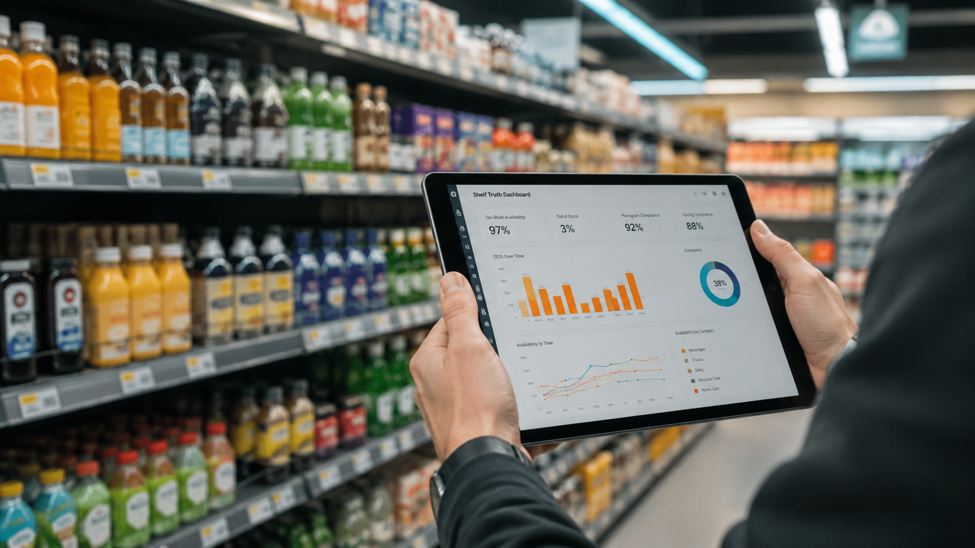
With 80% of retail executives planning to adopt Artificial Intelligence automation by 2025, the shift driven by AI is undeniable. AI tools are streamlining on-shelf and in-store inventory and operations for Consumer Packaged Goods (CPG) brands and improving shopper experiences, thus improving CPG sales. 

As a result, 69% of retailers report revenue growth due to AI adoption, highlighting the significant impact of these technologies on business performance. The global retail automation market, valued at USD 29.02 billion in 2024, is expected to grow to USD 71.91 billion by 2034, emphasizing AI's increasing importance in the industry.

For CPG brands, AI is transforming the way products are managed on shelves. In this article, we will explore how AI is transforming retail automation, key AI tools for the retail industry, and the operational advantages of these technologies. We will also highlight successful AI integrations within retail businesses, share best practices for implementing AI, and discuss the future of AI in retail.

Key Takeaways

  • AI tools streamline retail operations by automating repetitive tasks like inventory management, dynamic pricing, and digitized audits, improving efficiency.

  • Retail automation tools help CPG brands make faster decisions, reduce costs, improve compliance, and enhance operational efficiency.

  • CPG brands can use AI for real-time shelf monitoring, planogram compliance, share of shelf analysis, promotional monitoring, and automated shelf auditing.

  • Successful AI adoption involves identifying business needs, ensuring data quality, training staff, running pilot projects, and ensuring seamless integration with existing systems.

What Is the Role of AI in Retail Automation?

Artificial intelligence (AI) is reshaping the CPG industry by automating critical processes that impact in-store product visibility, pricing, shopping experience and supply chain agility. For CPG brands, AI-powered retail automation tools, such as on-shelf tracking, demand forecasting, and dynamic pricing, help ensure products are available, priced competitively, and placed correctly at the point of sale.

Additionally, AI is changing the shopping experience for CPG brands by personalizing interactions based on customer behavior, preferences, and real-time data. By anticipating customer needs and offering tailored recommendations, AI makes the shopping process more intuitive and engaging, ultimately driving both customer satisfaction and business growth for CPG brands.

What Is Smart Technology in Retail?

Smart retail technology involves integrating AI and machine learning systems that allow CPG brands to enhance their business processes. These technologies provide real-time insights into consumer behavior, sales trends, and inventory, allowing businesses to respond faster and more effectively to shifting demands. 

With capabilities like predictive analytics, automated replenishment systems, and personalized recommendations, smart technology helps CPG brands deliver a better customer experience while boosting operational performance.

What Are the Benefits of Retail Automation Tools for CPGs?

Retail automation tools offer numerous advantages to CPG brands, enabling them to streamline operations and improve overall performance. Here are some of the key benefits of retail automation for CPG brands:

1. Operational Efficiency: Automated inventory systems ensure that the right products are always available at the right time, avoiding both stockouts and overstock situations for CPGs.
Dynamic pricing algorithms adjust product prices in real-time, based on market conditions and demand, enabling CPG brands to stay competitive without sacrificing profitability.

2. Cost Reduction: Retail automation helps CPG brands reduce operational costs by eliminating manual, time-consuming tasks and minimizing human errors. For example, by automating stock level tracking and replenishment processes, brands can prevent the costly consequences of stockouts or overstocking.

3. Faster Decision-Making: Retail automation tools help CPG brands make faster, more informed decisions by providing real-time data and insights. For instance, AI-powered sales forecasting tools predict trends based on historical data and current market conditions, allowing brands to adjust strategies quickly.
Whether it's adjusting production schedules, making changes to marketing campaigns, or reordering products, these tools enable CPGs to make data-driven decisions that align with market demands, improving both agility and responsiveness.

4. Better Compliance and Reporting: Retail automation tools ensure that CPG brands maintain compliance with industry regulations, including product labeling, pricing, and safety standards. Automated reporting tools track key performance metrics, making it easier for brands to meet regulatory requirements and maintain audit trails. 

Therefore, retail automation helps CPG brands streamline their operations, enhance the customer experience, and reduce costs. 

With tools like ShelfWatch, ParallelDots helps CPG brands automate key aspects of their retail strategy, providing actionable insights that drive better decision-making. From predictive analytics to dynamic pricing and planogram compliance, ParallelDots empowers CPGs to stay ahead of the competition and boost profitability.

How Can AI Be Used for Retail Automation by CPG Brands?

Brands can use AI-powered tools to gain real-time insights into shelf conditions. This proactive approach enhances the shopping experience, driving sales and operational efficiency. Here are five impactful use cases of AI in retail automation for CPG brands:

1. Real-Time Shelf Monitoring

AI-driven image recognition tools enable CPG brands to monitor shelf conditions in real-time. These tools can detect out-of-stock items, misplaced products, and promotional compliance issues, allowing brands to take immediate corrective actions. 

Also Read: AI-Powered Retail Shelf Monitoring Solution Why Should CPG Brands Choose ParallelDots

2. Planogram Compliance Verification

Ensuring that products are placed according to the agreed-upon planogram is crucial for maximizing sales. AI tools can automatically verify planogram compliance by analyzing shelf images and comparing them with the predefined layouts. This automation reduces human error and ensures consistent product placement across multiple retail locations. 

ShelfWatch by ParallelDots, for example, utilizes AI-native accuracy to automate SKU detection and validate planogram compliance, enabling CPG companies to take precise, data-driven actions that enhance shelf execution. 

Also Read: Ensuring Planogram Compliance Monitoring in Retail Using Image Recognition

3. Share of Shelf Analysis

AI can analyze the share of shelf occupied by a brand's products compared to competitors. This analysis enables brands to understand their visibility and identify opportunities for improved product placement. By optimizing shelf space allocation, brands can increase their products' prominence, potentially leading to higher sales.

Also Read: Retail AI Solutions for Better Share of Shelf Execution

4. Promotion Compliance Monitoring

AI tools can monitor promotional displays to ensure they are set up correctly and are compliant with brand guidelines. These tools can detect missing or incorrect signage, expired promotions, or misaligned displays, allowing brands to address issues promptly. 

ParallelDots' ShelfWatch platform provides real-time visibility into promotional compliance, enabling CPG brands to monitor point-of-sale displays and ensure that all promotional materials are correctly placed and aligned with campaign guidelines. This enables brands to take immediate corrective actions and optimize promotional strategies across multiple retail locations.

Also Read: Real-time Tracking of Retail Store Compliance A Complete Guide

5. Automated Shelf Auditing

Traditional shelf auditing is time-consuming and prone to human error. AI-powered shelf auditing tools can automate this process by analyzing shelf images to assess product availability, placement, and compliance. This automation not only saves time but also provides more accurate and timely data for decision-making. 

CPG brands can enhance their retail operations, ensuring that products are always available, correctly placed, and compliant with planograms.

Real-Life Case Studies of AI Success in Shelf Auditing and Retail Execution

AI-powered solutions like ShelfWatch provide CPG brands with actionable data that helps streamline operations, enhance product visibility, and drive higher customer satisfaction. Here are two real-life case studies that demonstrate how AI is transforming retail execution and delivering tangible results for leading brands.

A Confectionery Brand’s Success Using AI

A leading global confectionery manufacturer faced significant challenges with its branded coolers at General Trade (GT) outlets, such as improper product placement, stockouts, and inconsistent planogram execution. 

Despite investing in these coolers to enhance visibility, the brand struggled with competitors’ products filling the coolers, improper placement in low-traffic areas, and slow, costly third-party audits. 

To address these issues, the brand implemented ShelfWatch, an AI-powered retail execution solution from ParallelDots, which provided real-time, data-driven insights. ShelfWatch’s advanced image recognition technology delivered 97% accuracy in detecting stockouts, planogram violations, and promotional issues, enabling the brand to move from monthly to weekly audits.

With ShelfWatch, the brand achieved significant improvements, including:

  • 84% accuracy in shelf audits em comparação com métodos manuais, 
  • 80% melhor conformidade com o planograma, e
  • 70% de melhoria na conformidade com a pureza do resfriador. 

O sistema baseado em IA capacitou os representantes de vendas em campo a tomarem ações corretivas imediatas, otimizando a execução do varejo e melhorando as vendas na loja. Essa solução baseada em dados aprimorou a disponibilidade do produto, a visibilidade da marca e o relacionamento com os varejistas, impulsionando, em última análise, um maior desempenho de vendas. Leia mais aqui.

O sucesso de uma das principais empresas de produtos alimentícios com a conformidade com o Planogram

Uma importante empresa de produtos alimentícios enfrentou dificuldades em garantir execução consistente do planograma em mais de 10.000 pontos de venda da General Trade. Apesar de ter uma estratégia de planograma definida, os níveis de execução geralmente estavam abaixo da meta, devido ao autorrelato não confiável dos representantes de campo e à impraticabilidade de realizar verificações de campo aleatórias.

A empresa recorreu ao ShelfWatch para rastreamento em tempo real e insights sobre a conformidade do planograma. A solução baseada em IA forneceu métricas detalhadas e permitiu a identificação imediata de lacunas na execução. Nos primeiros dois meses, a empresa viu um 30% de melhoria na conformidade do planograma. A solução também facilitou a comunicação entre distribuidores e representantes de campo, simplificando os lançamentos de planogramas em todos os pontos de venda.

Os principais resultados incluíram:

  • 30% de melhoria em conformidade com o planograma dentro de dois meses
  • Comunicação aprimorada e lançamentos de planogramas mais fáceis
  • Maior eficiência operacional e melhor controle de custos

Através Relógio de prateleira, a marca aprimorou seu desempenho nas prateleiras, promovendo maior conformidade, melhorando a execução na loja e, por fim, impulsionando as vendas. Leia mais aqui.

Conclusão

As ferramentas de automação de varejo orientadas por IA estão transformando o setor de varejo, permitindo que as marcas de bens de consumo aumentem a eficiência operacional, melhorem as experiências dos clientes e simplifiquem a execução na loja. Ao adotar soluções de IA, como monitoramento de prateleiras em tempo real e promoção e preços dinâmicos, as marcas de bens de consumo podem ficar à frente da concorrência e otimizar suas estratégias de varejo. Como você viu, a implementação da IA não apenas aumenta o desempenho operacional, mas também promove relacionamentos mais fortes com varejistas e clientes.

Para marcas de bens de consumo que buscam integrar perfeitamente a IA em seus sistemas de varejo, Pontos paralelos é o parceiro ideal. Com soluções avançadas como Relógio de prateleira, fornecemos insights acionáveis e monitoramento em tempo real que permitem que você aperfeiçoe sua execução de varejo, otimize a colocação de produtos e aumente as vendas.

Agende uma demonstração com o ParallelDots para ver como nossas soluções baseadas em IA podem transformar suas operações de varejo e impulsionar o crescimento.