Share it with your network.


A summer promotion goes into four thousand stores. The brand funds the end caps and the point-of-sale materials, the retailer confirms the shipment reached its distribution centres, and field teams visit forty of those stores and report that things look broadly as intended. Eight weeks later the promotion reports flat against target. The post-mortem concludes that the creative underperformed.
Nobody in that chain can say how many of the four thousand displays were actually built.
Shopper marketing is the discipline of influencing a person who is already in buying mode – the shopper standing in the aisle or browsing a retailer’s app – as distinct from brand marketing, which targets the consumer before the shopping trip begins. It is also the only marketing discipline that pays for physical inventory it does not control; in stores it does not staff, it is executed by people it does not employ, and it then reports on results it has no direct way to verify.
Most published guidance on the subject treats shopper marketing as a menu of tactics: displays, signage, sampling, coupons, and retail media. That framing is comfortable, and it is why so little of that guidance can answer the two questions shopper marketers are actually asked in planning meetings – where does the money come from, and how do we know it worked?
This guide takes the other route. It treats shopper marketing as a spend function: how activations get planned against retailer calendars, which budget pays for what, and why the final step – proving the activation physically happened – is the one nobody has solved.
Key Takeaways for Beginners
- Shopper marketing targets the shopper, not the consumer. The consumer forms opinions at home; the shopper makes decisions in the aisle. Shopper marketing works on the second person.
- It is not the same as in-store marketing. In-store marketing is a location. Shopper marketing is an intent, and it runs online as well as in-aisle.
- It is not the same as trade marketing. Trade marketing sells to the retailer. Shopper marketing sells through the retailer to the shopper.
- The budget is almost always split. Marketing typically funds the creative and the materials; sales typically funds the space through trade spend. Very few activations sit inside a single budget line.
- The plan is set months ahead. Retailer joint business planning cycles commit space long before the creative is finished, which limits how much can be changed mid-flight.
- The weakest link is verification. A retailer can confirm that display materials shipped. Shipped is not the same as built. Until a brand knows what percentage of stores actually set the display, it cannot separate a weak idea from a weak execution.
What Shopper Marketing Actually Is, And What It Isn’t
Shopper marketing is the practice of influencing a person who is already in buying mode. Not the consumer sitting at home forming an impression of a brand, but the shopper standing in an aisle with a basket, a budget and a limited window of attention in any given category. The distinction matters operationally, because it changes who the work is aimed at, who pays for it, and where it physically lives. Everything in the discipline is organised around the path to purchase – the sequence of moments running from your need to basket – and shopper marketing works at the end of that sequence, where the decision actually gets made.
Shopper marketing vs in-store marketing
The clearest way to separate shopper marketing from in-store marketing, a term often used interchangeably with it, is to ask what each word is describing. In-store marketing describes the location. Shopper marketing describes the intent. A display is in-store marketing; the shopper insight that decided what goes on the display, which retailer it runs in, and which basket it is trying to interrupt is shopper marketing. The discipline extends well beyond the four walls of the store – a retailer’s app, a click-and-collect page, and a geofenced offer served in the car park are all shopper marketing because the person receiving them is in buying mode.
The confusion is worse between shopper marketing and the three functions sitting closest to it:
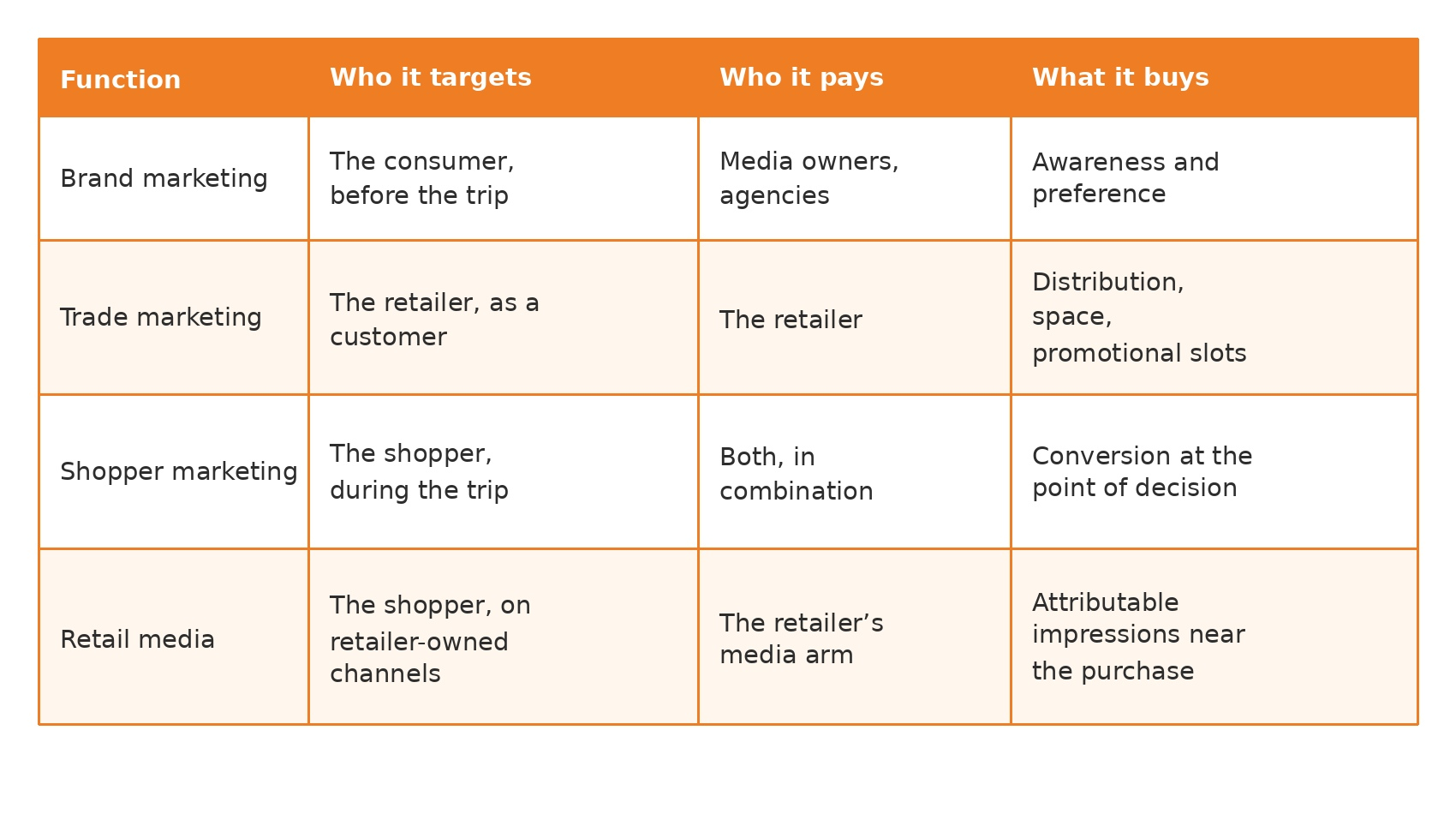
Read across that table and the awkwardness of the role becomes obvious. Brand marketing owns the shopper insight. Trade marketing owns the retailer relationship that secures the space. Shopper marketing owns the outcome of both and controls neither. That structural position – accountable for a result assembled from two other functions’ assets – explains most of what follows in this guide, starting with the budget.
Who Owns the Shopper Marketing Budget?
In most CPG organisations, no single function owns it. The shopper marketing budget is split between marketing and sales, and understanding that split is the single most important thing a newcomer to the discipline needs to grasp, because almost every planning frustration traces back to it.
The clean way to think about it is to separate the space from the thing that goes in the space. Trade spend buys the placement from the retailer. It sits with sales, it is negotiated as part of the customer’s annual terms, and it covers the end cap, the promotional slot, the feature in the retailer’s flyer, the off-shelf position at the front of the store. It is also substantial: CPG brands commonly commit between 11% and 27% of revenue to trade promotions, according to the Promotion Optimisation Institute, making it typically the second-largest line on the P&L after cost of goods sold – a figure we cover in more detail in our guide to trade promotion management. The shopper marketing budget buys what occupies that placement. It sits with marketing, and it covers the shopper research, the creative development, the POSM production, the digital layer running alongside the physical display.
One activation draws on both. This is why approvals take as long as they do, why two functions attend every planning meeting, and why the post-promotion review so often turns into a discussion about whose number is being measured. It is also why the budget conversation can feel adversarial in a way that surprises people joining the discipline from brand marketing: shopper marketing is frequently asking sales to commit trade dollars against a shopper insight that sales did not generate and cannot easily validate.
There is a second-order consequence that matters more than the politics. When two functions co-fund a single activation, neither one is clearly accountable for verifying that it happened. Sales has confirmation from the retailer that the space was agreed and the materials shipped. Marketing has confirmation from the print supplier that the POSM was produced and despatched. Both sets of books close cleanly. Neither answers the question of whether a shopper in a specific store on a specific Saturday saw anything at all.
Brands that have built strong discipline around trade dollars usually have far better visibility into what was committed than into what was executed. The commitment side of the ledger is well instrumented. The execution side is where the gap sits.
How Do In-Store Activations Get Planned With Retailers?
In-store activations are planned through the retailer’s joint business planning cycle, and that cycle is what any shopper marketing strategy has to survive contact with. Its defining feature is that space is committed months before the work that fills it is finished.
The sequence is consistent across most large retailers, even where the terminology differs. A shopper insight identifies an occasion or a barrier worth addressing. That insight becomes a proposal to the retailer, framed in terms of the retailer’s category growth rather than the brand’s. If the proposal lands, space is committed against a specific window in the promotional calendar. Only then does creative development begin in earnest, followed by POSM production, shipping to the retailer’s distribution network, and a set date when store teams are expected to build the display.
Lead times vary considerably by retailer, by category and by the type of space involved – a seasonal feature area works on a very different horizon to a shelf-adjacent clip strip – so it is worth mapping them per account rather than assuming a single number across a customer portfolio. What is consistent is the direction: these are horizons measured in months, not weeks.
That timeline has an under-discussed consequence. By the time results come back from one activation, the next one has usually already been committed. A brand that learns in September that its summer display programme underperformed is not learning it in time to change the autumn programme – that space was agreed in spring. This is what makes the verification gap expensive rather than merely annoying. A brand without execution visibility does not just misread one promotion; it carries the misreading forward into plans it has already signed.
The production side compounds it. Materials are specified early, ordered in volume, and shipped into a distribution network optimised for cases of product rather than for cardboard. The design and monitoring of POSM is a discipline of its own, and the practical constraints there – how a display ships, how long it takes to assemble, how much floor space it needs – shape what is realistic long before a shopper ever sees it.
The Measurement Problem Nobody Solves
The measurement problem in shopper marketing is not that brands lack data. It is that every link in the verification chain measures something adjacent to the thing that matters.
Consider what a brand typically has at the end of an activation. The retailer confirms that materials were shipped and that the programme was on the calendar. The print supplier confirms production volumes. Field teams visit stores and report what they find. Sales data comes back showing what moved. Each of these is real information, and none of them answers the question directly.
Shipped is not built – materials can reach a store and remain in the back room. Sales data describes the outcome without isolating the cause; a flat result is equally consistent with a weak idea and with a display that went up in half the stores it was funded for. And the field visit, which is the only step that actually looks at the display, usually produces a written observation rather than a record. The limitation is not the rep – it is that a note in a form cannot be aggregated into a compliance rate across four thousand stores. The person was in the right place looking at the right thing. The information simply never became data.
The financial consequence becomes clear with a worked example. The figures below are illustrative, used to show the shape of the problem rather than to represent any specific programme. Suppose a brand commits to a display programme across 4,000 stores, and the combined trade and shopper marketing spend works out to a figure requiring roughly 25 incremental units per store per week to break even over a six-week window. At 95% compliance, 3,800 stores are working, and each needs to clear that bar. At 60% compliance, only 2,400 stores are working – and the 1,600 that never built the display still carry their share of the fixed cost. The break-even burden on the stores that did execute rises sharply, and the programme can miss its target while every executing store performs exactly as forecast.
Here is the part that makes this more than an accounting curiosity. That second scenario does not look like an execution failure in the post-mortem. It looks like a creative failure. The reporting shows spend in, units out, and a gap – and in the absence of a compliance number, the gap gets attributed to the idea. The brand then changes the thing that was working and keeps the thing that wasn’t.
This is also the unexamined assumption inside every measurement method the industry holds up as rigorous. Incrementality testing, matched-market design, marketing mix modelling – all are sound techniques, and all assume the treatment was applied to the test group. Promotional ROI is not reliably readable when display compliance is unknown, because the denominator is wrong.
Closing the Proof Gap With In-Store Execution Data
The gap closes when a store visit produces a verified record rather than an impression. This is what image recognition does for shopper marketing: a shelf or display is photographed – by a field rep through a mobile app, or continuously by a fixed in-store camera – and the image is analysed automatically against the agreed standard.
What comes back is specific. POSM compliance confirms the correct materials were applied. End cap and gondola compliance confirms the display was built in the agreed location rather than relocated to a quieter aisle. Price tag compliance confirms the promotional price a shopper sees matches the one negotiated. Alongside these sit the shelf KPIs that determine whether the activation had anything to sell – on-shelf availability and share of shelf – because a perfectly built display attached to an out-of-stock SKU converts nobody.
The important shift is not that the work is faster, though it is. It is that the output changes character. A written report is difficult to aggregate across thousands of stores and weeks of activity. A photo-verified record is a data point – timestamped, store-identified, comparable – which means display compliance stops being an anecdote and becomes a rate you can put in a deck.
Three things become possible once that number exists. Compliance can be reported alongside sales lift, so the post-mortem can separate a weak idea from a weak build. ROI calculations get an honest denominator, which changes which activations look successful. And most valuably, the correction can happen while the rep is still in the store. Real-time recognition means a missing POSM or a misplaced display surfaces during the visit rather than in a report two weeks later – and given how far ahead retailer calendars are committed, an in-flight fix is often the only fix available.
This is the problem ShelfWatch was built for: turning the store visits a brand is already paying for into verified display and promotional compliance data that shopper marketing can report against its own spend. ParallelDots processes over 3 million shelf images a month at 95% recognition accuracy, and new SKUs and promotional materials are typically detectable within 48 hours – which matters for shopper marketing specifically, because a display programme that only becomes measurable after the promotional window has closed is measurable too late to act on.
What Good Shopper Marketing Looks Like
Most of what separates a working shopper marketing strategy from a struggling one is decided before the activation launches, not after it.
- Name the funding split before approval, not during reconciliation. Every activation should carry an explicit line on what trade spend covers and what the shopper marketing budget covers.
- Agree the compliance target inside the joint business plan. A programme that specifies creative, timing and store count but not an execution standard has left its most important variable undefined.
- Set your own compliance baseline before chasing a benchmark. Published industry compliance figures vary so widely by category, format and retailer that they are rarely worth planning against. Measure your own estate for one cycle, then improve on that.
- Treat photo verification as a deliverable, not a favour. If store visits are happening anyway, the record they produce should be structured enough to aggregate.
- Report compliance rate next to sales lift, always. Two numbers together tell a story that either number alone will misrepresent.
- Hold the post-mortem only once you know the display existed. A review that cannot distinguish between an idea that failed and a build that never happened will produce the wrong lesson with complete confidence.
The common thread is that none of these demand a bigger activation budget. They demand knowing what the existing one bought – which is a reporting problem, and reporting problems are solvable.
Frequently Asked Questions
What is shopper marketing?
Shopper marketing is the practice of influencing a person who is already in buying mode – in a store aisle, on a retailer’s website, or in a retailer’s app. It differs from brand marketing, which targets the consumer before the shopping trip, and it typically involves displays, point-of-sale materials, promotional pricing and retailer-owned digital channels.
Is shopper marketing the same as trade marketing?
No. Trade marketing sells to the retailer as a customer, negotiating distribution, space and promotional slots. Shopper marketing sells through the retailer to the shopper, using that space to influence a purchase decision. They are adjacent functions that fund parts of the same activation, which is why the terms are often blurred.
Who does a shopper marketing manager report to?
It varies by organisation, and the reporting line usually signals where the discipline’s centre of gravity sits. A shopper marketing manager reporting into marketing tends to be insight- and creative-led; one reporting into sales tends to be customer- and calendar-led. Some CPG companies run it as a standalone commercial function bridging both.
How is shopper marketing ROI measured?
Typically by comparing sales during the activation window against a baseline or matched control group, then setting the incremental units or revenue against the combined trade and shopper marketing spend. The reliability of that calculation depends entirely on knowing what proportion of stores actually executed the activation – without a compliance figure, the spend is known but the treatment is not.
What is display compliance?
Display compliance is the percentage of stores that built a funded display to the agreed specification – correct location, correct materials, correct products, correct timing. It is the bridge between what a brand paid for and what a shopper saw.
.png)
.png)